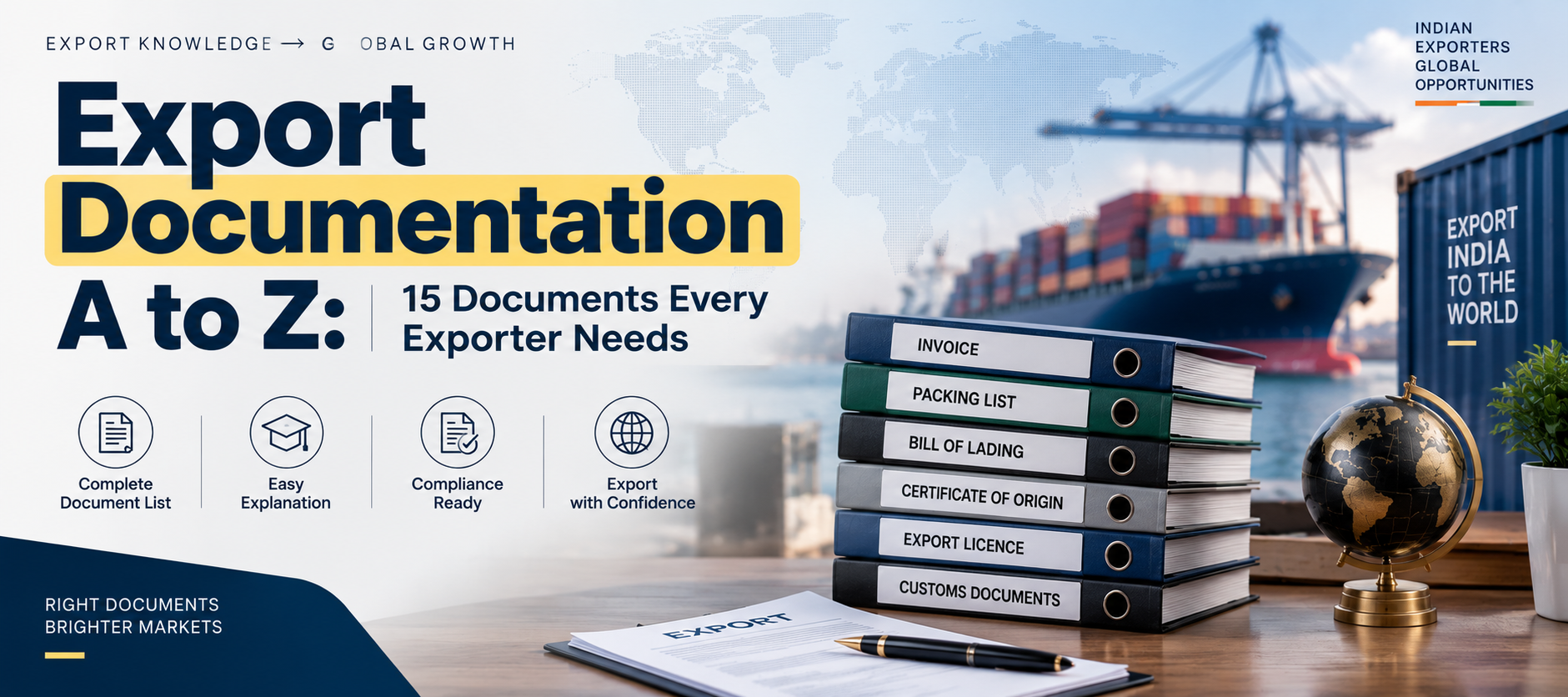
Export Documentation A to Z: 15 Documents Every Exporter Needs
A small mistake in an invoice, packing list, or Bill of Lading can cause shipment delays, customs issues, and payment problems. Learn the 15 essential export documents every Indian exporter must know — with examples, uses, and a practical checklist.
Export Documentation A to Z: 15 Documents Every Exporter Needs
Starting an export business from India is not only about finding international buyers and shipping products. One of the most important parts of international trade is export documentation.A small mistake in an invoice, packing list, shipping bill, or Bill of Lading can cause shipment delays, customs issues, payment problems, or additional costs.
For Indian exporters, the exact documents required depend on the product, destination country, mode of transport, payment terms, buyer requirements, and applicable regulations. DGFT lists the core mandatory export documents as the transport document, commercial invoice-cum-packing list, and shipping bill/bill of export — while additional documents can be required for specific products or regulatory conditions.
Instead of trying to memorize hundreds of documents, an exporter should understand the purpose of each document and when it is required.
Here are 15 important export documents every exporter should know.
---
1. Import Export Code (IEC)
The Import Export Code (IEC) is a key registration for businesses involved in import and export activities from India. It is issued through the Directorate General of Foreign Trade (DGFT).Example:
An Indian furniture manufacturer receives an export order from a buyer in Germany. Before executing the export transaction, the business needs to have the appropriate IEC registration.IEC connects your business with the Indian foreign trade system and is an essential part of the export setup.
---2. Commercial Invoice
The Commercial Invoice is one of the most important export documents. It contains details such as:- Exporter and buyer details
- Product description
- Quantity and unit price
- Total value and currency
- HS Code (where applicable)
- Incoterms and payment terms
- Country of origin (where applicable)
Example:
If you export 500 chairs at USD 40 each:| Detail | Value |
|---|---|
| Quantity | 500 |
| Unit Price | USD 40 |
| Total Value | USD 20,000 |
The commercial invoice is also important for customs valuation and documentation.
---3. Packing List
The Packing List explains how the goods are packed. It can include:- Number of cartons and dimensions
- Gross weight and net weight
- Product quantity and package numbers
- Volume/CBM and shipping marks
Example:
| Detail | Value ||---|---|
| Product | Wooden Chairs |
| Quantity | 100 |
| Cartons | 50 |
| Packing | 2 chairs/carton |
| Gross Weight | 750 kg |
| Total CBM | 12.5 |
DGFT permits a combined Commercial Invoice cum Packing List, while separate documents are also accepted.
---4. Shipping Bill
The Shipping Bill is a key customs document for exports from India. It contains information about the exporter, buyer, product, HS Code, quantity, value, port of loading, destination, and export scheme or benefit (where applicable).It is filed with Customs — generally through the electronic customs system — as part of export clearance.
Simple explanation: Shipping Bill = Customs declaration for your export shipment. Without completing the applicable export customs process, the shipment cannot legally move out of India.
---5. Bill of Lading (B/L)
A Bill of Lading is an important document used for sea shipments. It is issued by the carrier or its agent and contains details such as:- Shipper and consignee
- Notify party and vessel
- Port of loading and discharge
- Cargo description, number of packages, and freight details
Example:
An exporter ships furniture from Nhava Sheva, India to Melbourne, Australia. After the cargo is loaded, the Bill of Lading provides evidence of the carriage details.The Bill of Lading is also important for certain payment arrangements, including transactions involving documentary requirements.
---6. Airway Bill (AWB)
For air exports, the equivalent transport document is the Airway Bill. It contains information about the shipper, consignee, airport of departure, destination airport, cargo, weight, number of packages, and flight/carrier details.Example:
An Indian exporter sends 50 kg of handicrafts from Delhi to Dubai by air. The shipment will have an Airway Bill instead of a sea Bill of Lading.DGFT includes Airway Bill among the transport documents that can form part of mandatory export documentation.
---7. Certificate of Origin
A Certificate of Origin (CoO) confirms the country in which the exported goods originate. For an Indian exporter, it establishes that the goods are of Indian origin, subject to the applicable rules.It may be required by the buyer, customs authority, trade agreement, import regulations, or bank and transaction requirements.
Example:
An Indian handicraft exporter sells products to a buyer in another country. The buyer may request a Certificate of Origin to support customs clearance or to establish eligibility under applicable tariff arrangements.The exact type and issuing process depend on the destination and applicable trade requirements.
---8. Proforma Invoice
A Proforma Invoice is generally prepared before the final commercial invoice. It acts as a quotation or preliminary invoice and can contain product details, quantity, price, Incoterm, payment terms, delivery details, and validity period.Example:
A US buyer asks: "Please send your price for 500 wooden chairs."The exporter sends:
Proforma Invoice — 500 Wooden Chairs — FOB Nhava Sheva — USD 25,000
After the buyer accepts the commercial terms and the shipment is executed, the final commercial invoice is prepared.
---
9. Purchase Order (PO)
A Purchase Order is issued by the buyer to formally communicate the order. It can specify product, quantity, price, specifications, delivery date, packaging, payment terms, and shipping requirements.Example:
| Detail | Value ||---|---|
| PO Number | US/CHAIR/2026/101 |
| Product | Wooden Dining Chair |
| Quantity | 1,000 |
| Price | USD 35/unit |
The exporter should carefully compare the PO with the quotation and agreed terms before accepting it.
---10. Letter of Credit (LC)
A Letter of Credit is a bank-related payment instrument used in international trade. It establishes conditions under which the bank will make payment against compliant documents.When an export order is under LC, document accuracy becomes extremely important. Typical documents may include Commercial Invoice, Packing List, Bill of Lading, Certificate of Origin, Insurance document, and Inspection certificate — depending on the LC terms.
Example:
A buyer opens an LC for USD 50,000. The exporter ships the goods but presents documents that do not comply with the LC requirements. This can result in a documentary discrepancy and potentially delay or complicate payment.Never treat LC documentation casually.
---11. Insurance Certificate / Policy
Depending on the Incoterm, contract, or buyer requirement, cargo insurance may be required. For example, under CIF, the seller has an insurance obligation under the Incoterms rule. The insurance document provides evidence of the relevant cargo insurance coverage.Example:
An exporter ships furniture worth USD 30,000 under terms requiring seller-arranged cargo insurance. The exporter obtains the applicable insurance document and provides it as required by the transaction.---
12. Inspection Certificate
Some buyers, products, countries, or contracts may require a pre-shipment inspection or inspection certificate. The inspection may verify quantity, product quality, specifications, packaging, and product condition.Example:
A buyer orders 2,000 metal chairs and specifies that an independent inspection company must inspect the shipment before dispatch. The exporter arranges the inspection according to the agreed requirements.An inspection certificate is not universally required for every export shipment. It depends on the product, buyer, country, and transaction.
---13. Fumigation Certificate
A Fumigation Certificate may be required for certain shipments — particularly where wooden packaging materials are used and the destination country's requirements apply. For example, an exporter using wooden pallets may need to comply with applicable ISPM 15 requirements.Example:
An Indian furniture exporter sends a shipment containing wooden pallets to Europe. The exporter and logistics team need to ensure the packaging complies with the applicable destination-country requirements.Always confirm the specific requirements before shipment.
---14. Bill of Exchange
A Bill of Exchange is a financial document used in certain international trade transactions. It is particularly relevant in transactions involving documentary collections, certain LC arrangements, or credit/payment structures.Example:
An exporter sells goods on a 60-day payment arrangement supported by the applicable trade-finance documentation. A Bill of Exchange may be used as part of the transaction structure.The exact requirements depend on the payment method and bank process.
---15. Export Declaration / Other Regulatory Documents
Depending on the product and destination, additional declarations, certificates, permits, or regulatory documents may be required. These can include documents related to:- Food products and agricultural items
- Chemicals and pharmaceuticals
- Plant products and organic products
- Animal products and restricted products
- Product-specific certifications
DGFT specifically notes that additional documents may be required where goods are subject to restrictions, policy conditions, NOCs, or product-specific statutory compliance. The idea that "every export shipment requires exactly the same documents" is incorrect — always prepare the checklist according to the specific shipment.
---Real-World Example: Export Documentation in One Shipment
An Indian furniture manufacturer receives an order from a buyer in the USA:| Detail | Value |
|---|---|
| Product | Wooden Dining Chairs |
| Quantity | 500 |
| Order Value | USD 25,000 |
| Shipment | Sea |
| Incoterm | FOB Nhava Sheva |
| Payment | 30% advance + balance on shipping documents |
Step 1 — Buyer Places the Order
The buyer sends a Purchase Order.Step 2 — Exporter Sends Proforma Invoice
The exporter prepares a Proforma Invoice showing 500 chairs, USD 25,000, FOB Nhava Sheva, payment terms, and delivery terms.Step 3 — Production and Packing
After production, the exporter prepares the Packing List:| Detail | Value |
|---|---|
| Quantity | 500 chairs |
| Cartons | 250 |
| Packing | 2 chairs/carton |
| Gross Weight | 3,750 kg |
| Total CBM | 30 |
Step 4 — Final Invoice
The exporter prepares the Commercial Invoice for the shipment.Step 5 — Customs Clearance
The applicable Shipping Bill is filed for export clearance.Step 6 — Cargo Movement
The shipment is loaded according to the agreed FOB arrangement.Step 7 — Bill of Lading
The shipping line issues the Bill of Lading.Step 8 — Certificate of Origin
If required by the buyer or destination-country requirements, the exporter arranges the Certificate of Origin.Step 9 — Bank / Payment Documentation
The exporter submits the required documents according to the agreed payment arrangement.This example shows why export documentation is not a collection of random papers — every document has a specific role in the export process.
---Export Documentation Checklist
| Document | Usually Required? | Purpose ||---|---|---|
| IEC | Yes | Exporter identification and authorization |
| Commercial Invoice | Yes | Transaction value and product details |
| Packing List | Yes | Packing and shipment details |
| Shipping Bill | Yes | Customs export declaration |
| Bill of Lading | Sea shipment | Transport document |
| Airway Bill | Air shipment | Transport document |
| Certificate of Origin | Depends on transaction | Country of origin |
| Proforma Invoice | Before order | Quotation / preliminary invoice |
| Purchase Order | Depends on buyer | Buyer's order |
| Letter of Credit | If applicable | Payment instrument |
| Insurance Certificate | If applicable | Cargo insurance evidence |
| Inspection Certificate | If required | Inspection compliance |
| Fumigation Certificate | If applicable | Packaging / fumigation compliance |
| Bill of Exchange | If applicable | Payment / finance document |
| Product-specific certificates | If applicable | Regulatory compliance |
Note: This is a practical checklist, not a universal legal requirement for every shipment. DGFT identifies three core mandatory export document categories, while additional documents may apply based on the product and transaction.
---Common Export Documentation Mistakes
1. Wrong Product Description
The description should be consistent across all applicable documents.2. Incorrect HS Code
The HS Code should be determined carefully based on the product and applicable classification rules.3. Invoice and Packing List Mismatch
Quantity, weight, cartons, and product descriptions must be checked and matched.4. Incorrect Buyer Details
Even a small error in consignee or notify-party details can create operational issues.5. Incorrect Incoterm
Always mention the Incoterm and named place clearly.Example: FOB Nhava Sheva — Incoterms® 2020
6. Ignoring Destination-Country Requirements
The buyer may require additional certificates or documents beyond the core Indian export documentation.7. Preparing Documents at the Last Minute
Documentation should be prepared and checked before shipment — not after the cargo has already moved.---
How GIFT Export Import Training Helps
Learning export documentation theoretically is very different from actually preparing documents for a real shipment.The GIFT Export Import Training Program by 10X Exports is a 45-day, 100% practical offline export-import training program. Its curriculum covers 250+ topics across 18 modules, including:
- Customs clearance and documentation
- Shipping and logistics
- Export-import processes
- GST and IEC
- Packaging
- International buyer finding
- Payment safeguarding
Buyer Inquiry → Quotation → Proforma Invoice → Purchase Order → Production → Packing List → Commercial Invoice → Shipping Bill → Customs Clearance → Shipment → Bill of Lading / AWB → Payment Documentation
The program emphasizes practical learning, live case studies, buyer communication, port visits, and executing export-import processes while learning — particularly useful for beginners who want to understand how export documentation works in a real transaction.
👉 Learn More — GIFT Export Import Training
Conclusion
Export documentation is the backbone of international trade. Finding an international buyer and receiving an export order is only the beginning. To execute the shipment successfully, exporters need to understand commercial invoices, packing lists, Shipping Bills, Bills of Lading, Airway Bills, Certificates of Origin, payment documents, and product-specific compliance documents.Remember: Correct product + correct HS Code + correct costing + correct documentation = smoother export execution.
Do not assume that every export shipment requires the same documents. Start with the core documentation and then add documents based on the product, destination country, buyer requirements, transport mode, and payment terms.Call To Action
For beginners who want to learn the process practically — GIFT Export Import Training by 10X Exports covers customs clearance, export documentation, shipping, logistics, payment safeguarding, buyer finding, and real export-import workflows.👉 Join GIFT Export Import Course in Ahmedabad
India's most practical export training — for students, beginners, and entrepreneurs.
🚀 Start with the documents. Understand the process. Execute your export shipment with confidence.
Tags
Frequently Asked Questions
What are the main export documents required from India?
The core mandatory export documents identified by DGFT are the transport document, Commercial Invoice cum Packing List, and Shipping Bill/Bill of Export. Additional documents may be required depending on the product, destination country, transport mode, and transaction structure.
What is the difference between a Proforma Invoice and a Commercial Invoice?
A Proforma Invoice is used before the order or shipment as a quotation or preliminary document showing price, quantity, and terms. A Commercial Invoice is the final transaction invoice used for the actual shipment, customs valuation, and payment processing.
Is a Certificate of Origin mandatory for every export from India?
No. A Certificate of Origin is not automatically required for every export shipment. It depends on the destination country, buyer requirements, applicable trade agreements, and transaction structure. Always confirm whether it is needed before shipment.
What happens if there is a mistake in export documentation?
A documentation error can lead to customs queries, shipment delays, documentary discrepancies, additional costs, or payment-related issues — depending on the document and transaction. For LC-based payments, even a minor discrepancy can delay or complicate payment significantly.
How many export documents does an exporter need for each shipment?
There is no fixed number. DGFT specifies three core mandatory document categories, while additional documents depend on the product, destination, transport mode, payment terms, buyer requirements, and regulatory conditions. Always prepare a shipment-specific documentation checklist.