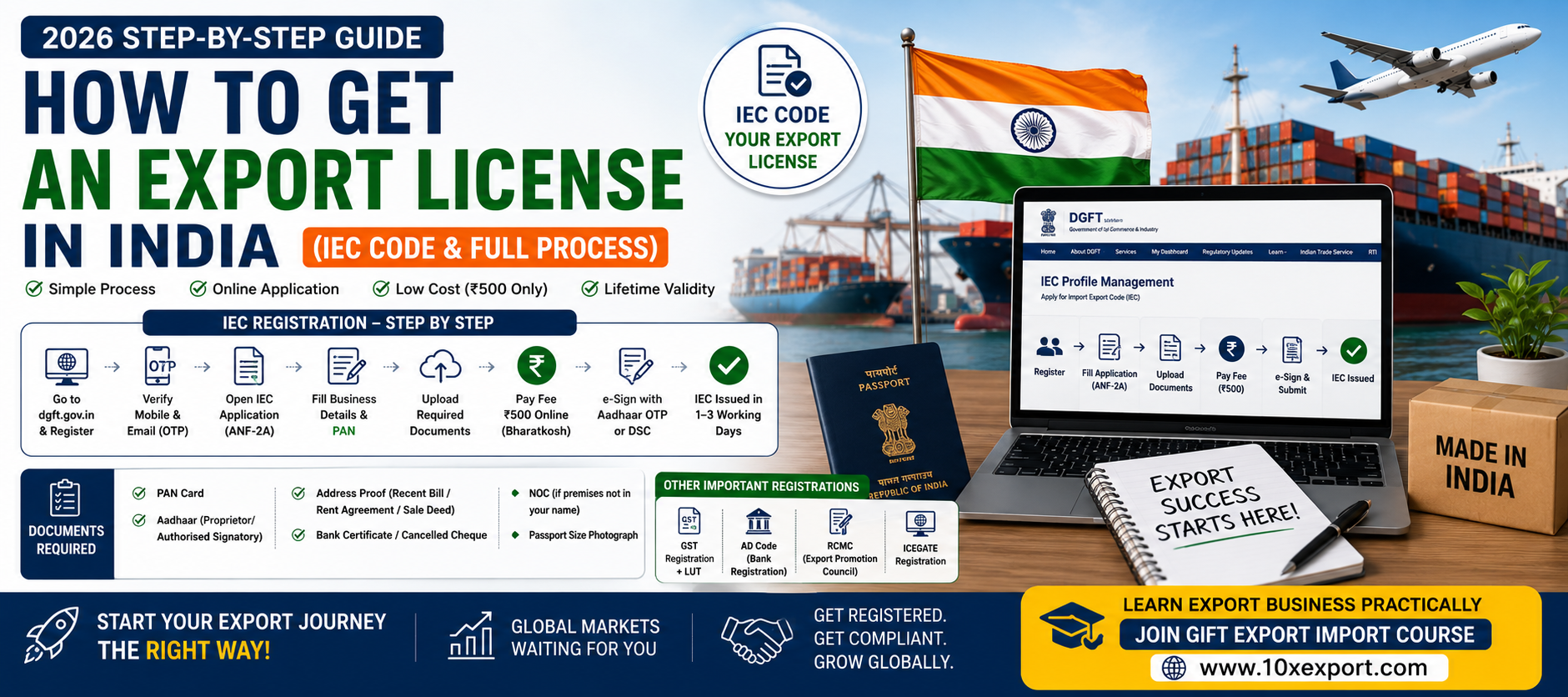
How to Get an Export License in India (2026 Step-by-Step Guide)
Need an export license in India? Learn how to get your IEC code on the DGFT portal — documents, fees, timeline, and the other registrations every exporter needs before their first shipment.
How to Get an Export License in India: A 2026 Step-by-Step Guide
If you want to export from India, the first question is: do I need an export license, and how do I get one? The short answer is yes — and the main one is simpler and cheaper to get than most beginners expect.This guide explains exactly what counts as an "export license" in India, how to get your IEC code through the DGFT portal in 2026, and the other registrations you will need before your first shipment leaves the port.
What is an "Export License" in India?
In India, there is not a single document literally called an "export license" for most products. The core registration every exporter needs is the Import Export Code (IEC) — a 10-digit number issued by the Directorate General of Foreign Trade (DGFT) under the Foreign Trade (Development and Regulation) Act, 1992.Without an IEC, customs will not clear your goods and banks will not process your foreign payments. So for the vast majority of exporters, the IEC is your export license.
Certain restricted or controlled goods — like specific chemicals, defence-related items, or items on the SCOMET list — need additional product-specific authorisations from DGFT. Most general products do not.
How to Get Your IEC Code: Step by Step (2026)
The entire IEC process is online and usually completed within a few days.Step 1 — Register on the DGFT Portal
Go to dgft.gov.in and register as a new user (importer/exporter).Step 2 — Verify Your Mobile and Email
Complete verification via OTP.Step 3 — Open the IEC Application
Navigate to Services → IEC Profile Management → Apply for IEC. This uses Form ANF-2A.Step 4 — Fill in Your Business Details
Enter your name, constitution (proprietorship, partnership, LLP, company, etc.), and PAN.Step 5 — Upload Your Documents
Upload all required documents in the prescribed format (list below).Step 6 — Pay the Government Fee
Pay ₹500 via the Bharatkosh gateway using net banking, debit card, or UPI.Step 7 — Sign the Application
Use Aadhaar-based OTP e-sign or a Digital Signature Certificate (DSC).Step 8 — Submit and Download
After submission and verification, the IEC is generally issued within 1–3 working days. Download it directly from the portal.Documents You Will Need for IEC
- PAN Card — proprietor's PAN for sole proprietorship; business PAN for LLP, company, or partnership
- Aadhaar — of the proprietor or authorised signatory (for OTP e-signing)
- Address Proof — recent electricity or telephone bill, rent or lease agreement, or sale deed. If the premises are not in your name, include an NOC from the owner
- Bank Certificate — in the prescribed format, or a cancelled cheque showing your name, bank name, and account number
- Passport-Size Photograph — of the proprietor or authorised signatory
Key Facts to Remember
- Fee: ₹500, one-time and non-refundable
- Validity: Lifetime — but you must complete an annual update between April and June each year, even if nothing has changed. Skip it and your IEC can be deactivated
- IEC = Your PAN: Since 2021, your IEC number is the same as your PAN — but you still have to formally apply
The Other Registrations Every Exporter Needs
Getting your IEC is step one. Before you can actually ship and get paid, you will typically also need:- GST Registration + LUT — Exports are zero-rated, but you need GST to file returns and either submit a Letter of Undertaking (LUT) for tax-free exports or claim IGST refunds
- AD Code Registration — Your bank's Authorised Dealer code, registered at your export port, so you can file shipping bills and receive foreign payments
- RCMC — A Registration-cum-Membership Certificate from the relevant Export Promotion Council — mandatory to claim FTP export incentives
- ICEGATE Registration — For filing shipping bills and customs documents electronically
Common Mistakes to Avoid
- Skipping the annual IEC update — The most common reason IECs get deactivated. Set an April reminder every year
- Wrong or mismatched documents — Address proof, bank details, and PAN must match exactly. Mismatches cause rejection
- Assuming IEC is all you need — You also need GST/LUT, AD Code, and usually RCMC before your first shipment
- Paying agents heavy fees for a ₹500 process — IEC is a simple DIY online application. You do not need to overpay
Call To Action
Registrations are the easy part — the real skill is using them to find buyers, ship correctly, and claim your incentives without costly mistakes. That is exactly what we teach hands-on in the GIFT Export Import Program.Start with our guide on How to Start a Career in Export Import, or
👉 Join GIFT Export Import Course in Ahmedabad
India's most practical export training — for students, beginners, and entrepreneurs.
🚀 Get export-ready in 2026 with GIFT Export Import Training.
Frequently Asked Questions
Do I need an export license to export from India?
Yes — the core one is the IEC (Import Export Code) from DGFT. For most products, the IEC is effectively your export license. Restricted or controlled goods need additional DGFT authorisations.
How much does an export license (IEC) cost in India?
The government fee is ₹500 — one-time and non-refundable. You do not need to pay agents for this; it is a simple DIY online process on the DGFT portal.
How long does it take to get an IEC in India?
Usually 1–3 working days after you submit a complete application with valid documents on the DGFT portal.
Is the IEC valid for life?
Yes, the IEC has lifetime validity — but you must complete a mandatory annual update between April and June every year. Skipping this can result in your IEC being deactivated.
What other registrations do I need besides IEC to export?
You will also need GST registration with LUT, an AD Code registered at your export port, RCMC from the relevant Export Promotion Council, and ICEGATE registration for filing customs documents electronically.