AD Code & RCMC Registration in India: A Beginner's Guide
Once you have your IEC, two registrations confuse almost every first-time exporter: the AD Code and the RCMC. This guide explains both in plain language — what they are, why you need them, and exactly how to register in 2026.
AD Code & RCMC Registration in India: A Beginner's Guide (2026)
Once you have your IEC, two registrations confuse almost every first-time exporter: the AD Code and the RCMC. They sound technical, but they are straightforward once you know what each one does.This guide explains both in plain language — what they are, why you need them, and exactly how to register in 2026. If you do not have your IEC yet, start with our Export License (IEC) Guide first — you need an active IEC before either of these.
What is an AD Code?
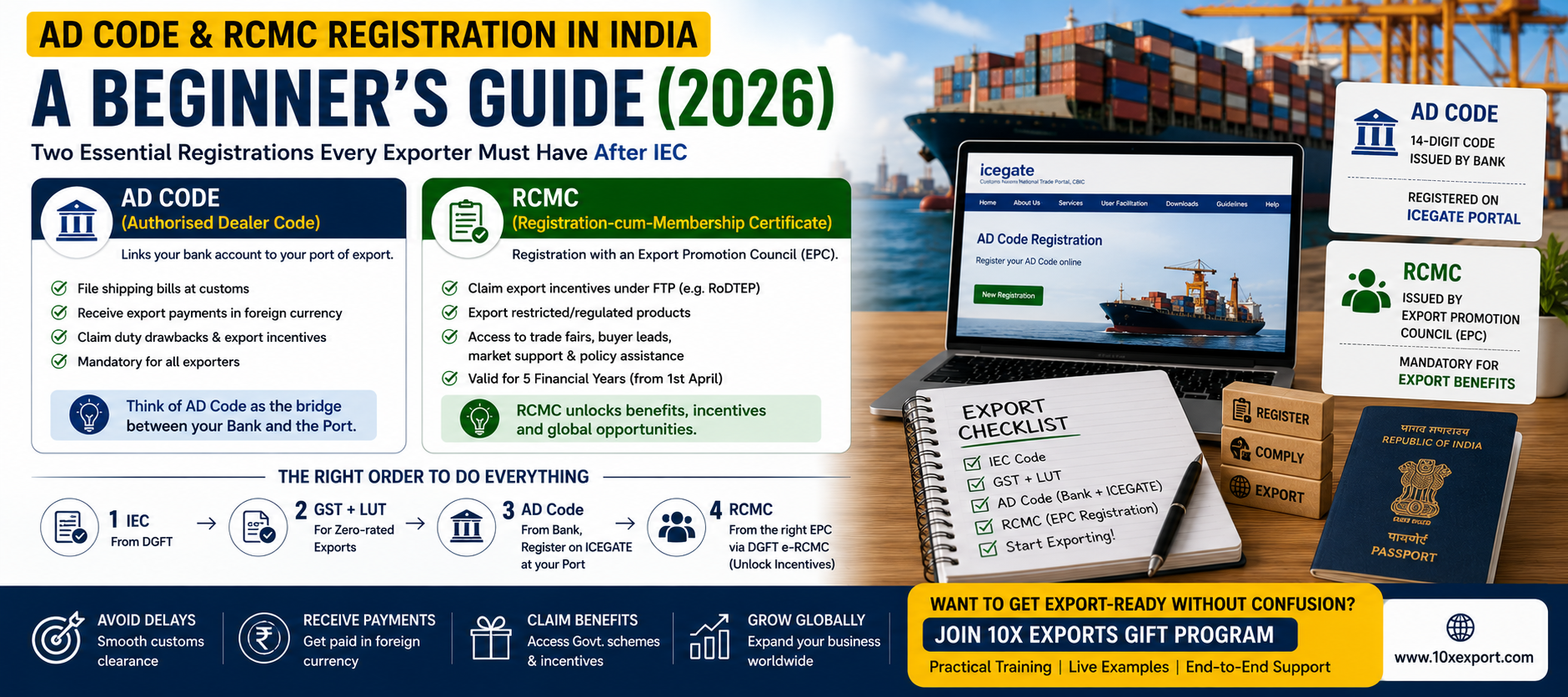
An AD Code (Authorised Dealer Code) is a 14-digit number issued by your bank that links your business bank account to your port of export. It is what allows you to:- File shipping bills at customs
- Receive foreign currency payments for your exports
- Claim duty drawbacks and export incentives directly to your account
How to Register Your AD Code: Step by Step
Step 1 — Request the AD Code Letter from Your Bank
Ask your bank (the one with your current account for export transactions) to issue an AD Code authorisation letter on its letterhead, in the DGFT/customs prescribed format.Step 2 — Register it on ICEGATE
AD Code registration is now done online through the ICEGATE portal (icegate.gov.in), linked to your IEC and GST.Step 3 — Register at Your Specific Port or Airport
The AD Code is registered per port — so if you export from a new port later, you register it there too.Done — it is a one-time registration at each port and does not expire.
Documents for AD Code
- AD Code authorisation letter from your bank (prescribed format)
- IEC certificate
- GST registration
- PAN and business proof
- Bank details (cancelled cheque or bank statement)
What is an RCMC?
RCMC (Registration-cum-Membership Certificate) is your official registration with a DGFT-recognised Export Promotion Council (EPC), Commodity Board, or Development Authority for your product category.You need it to:
- Claim export incentives and concessions under the Foreign Trade Policy — no RCMC means no benefits like RoDTEP claims through your council
- Export restricted or regulated goods that require it
- Access your council's support — trade fairs, buyer leads, market access programs, and policy help
How to Register for RCMC: Step by Step
Step 1 — Identify the Right Council for Your Product
There are dozens of EPCs and commodity boards — for example, engineering, textiles (AEPC), gems and jewellery (GJEPC), chemicals, spices board, tea board, and more. DGFT lists all registering authorities in Appendix 2T of the FTP.Step 2 — Use FIEO for Mixed Categories
If you export multiple unrelated categories, you can register with FIEO (Federation of Indian Export Organisations).Step 3 — Apply Online via the DGFT e-RCMC Platform
Go to dgft.gov.in → Services → e-RCMC → Apply. It is a common digital portal — you apply centrally.Step 4 — Declare Your Main Line of Business
Fill in your business details and attach the required documents.Step 5 — Pay the Council Fee
Each EPC sets its own fee — pay accordingly.Step 6 — Sign and Submit
Sign with DSC or Aadhaar e-Sign and submit. The certificate is then issued by the council.Key Facts About RCMC
- Validity: 5 financial years, deemed valid from 1 April of the licensing year
- Prerequisite: An active IEC with an updated profile
- When it must be valid: DGFT requires your RCMC to be valid on the date you apply for any benefit or concession under the FTP — keep it current to keep your incentives flowing
Documents for RCMC
- Active IEC certificate
- PAN of the business
- GST registration certificate
- Business proof (incorporation certificate, partnership deed, LLP agreement, or proprietorship proof)
- Declaration of main line of business
The Right Order to Do Everything
For a smooth start, register in this sequence:- Step 1 — IEC (from DGFT) — see our Export License Guide
- Step 2 — GST + LUT — to handle zero-rated exports
- Step 3 — AD Code — from your bank, registered on ICEGATE at your port
- Step 4 — RCMC — from the right EPC, via DGFT e-RCMC, to unlock incentives
Do these in order and you will avoid the classic "shipment stuck at port" or "cannot claim my refund" problems.
Once RCMC is in place, you can claim schemes like RoDTEP — see our RoDTEP Scheme 2026 guide to improve your margins from day one.Common Mistakes to Avoid
- Applying for RCMC before IEC is active or updated — RCMC needs a valid, updated IEC profile. Do IEC first
- Choosing the wrong EPC — Register with the council that matches your main product, or use FIEO for mixed categories
- Forgetting AD Code at a new port — AD Code is per-port. Exporting from a new port means a new registration there
- Letting RCMC lapse — If it is expired on the date you apply for a benefit, your incentive claim can be rejected. Track the 5-year validity
- Paying agents for what you can do online — Both AD Code (ICEGATE) and RCMC (e-RCMC) are online, DIY-friendly processes
Call To Action
Registrations are simple once someone shows you the order and the shortcuts. We walk students through IEC, AD Code, RCMC, and their first real shipment — practically — in the GIFT Export Import Program.👉 Join GIFT Export Import Course in Ahmedabad
India's most practical export training — for students, beginners, and entrepreneurs.
🚀 Get export-ready in 2026 with GIFT Export Import Training.
Tags
Frequently Asked Questions
What is the difference between AD Code and RCMC?
An AD Code links your bank account to your export port — needed to ship goods and receive foreign payments. RCMC registers you with an Export Promotion Council — needed to claim export incentives under the Foreign Trade Policy. You need both.
Is AD Code registration mandatory for export from India?
Yes. Without an AD Code registered at your port, customs will not process your shipping bill and you cannot receive foreign currency payments for your exports.
Is RCMC mandatory for Indian exporters?
It is mandatory to claim FTP export incentives and to export certain restricted goods. Even otherwise, it is strongly recommended as it unlocks benefits like RoDTEP claims, trade fair access, and buyer leads through your Export Promotion Council.
How long is an RCMC valid?
An RCMC is valid for five financial years, deemed valid from 1 April of the licensing year. Keep track of its expiry — if it lapses on the date you apply for a benefit, your incentive claim can be rejected.