General
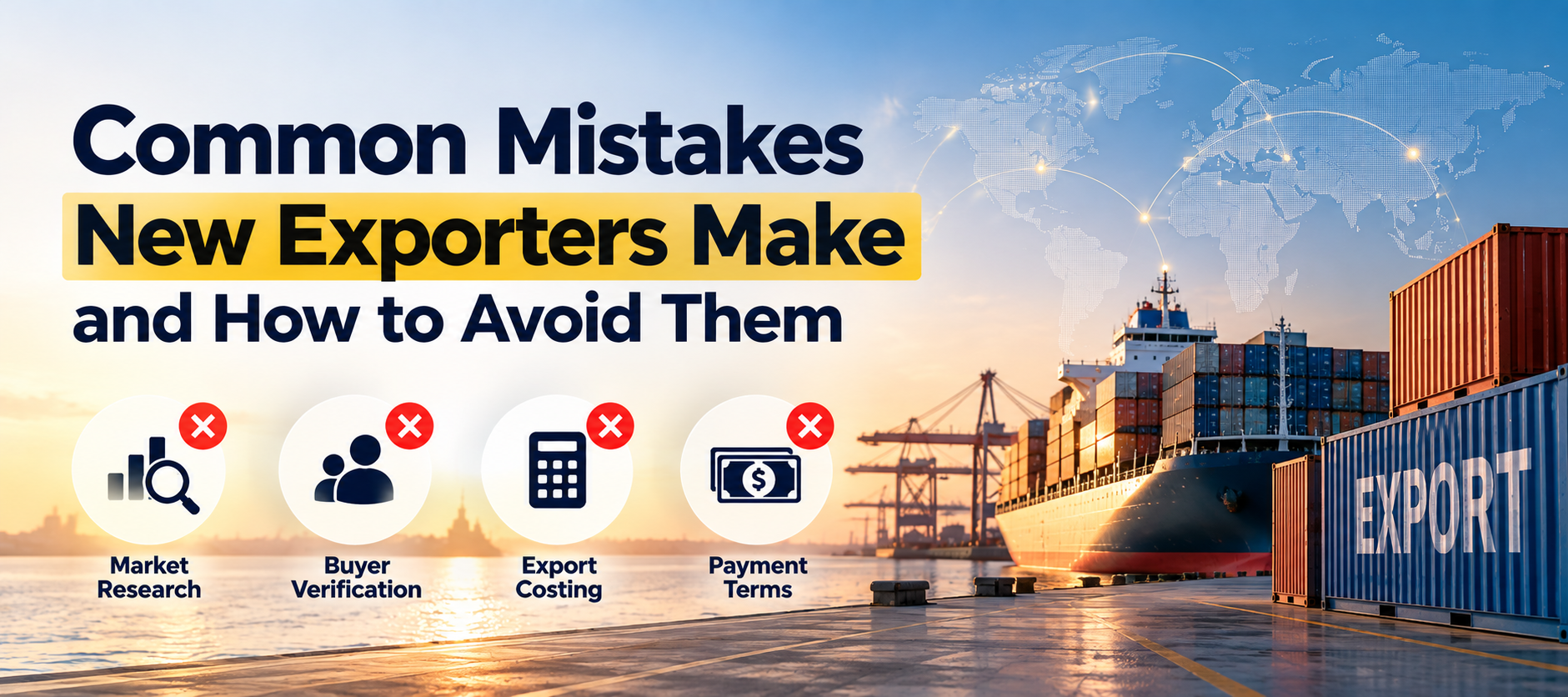
Common Mistakes New Exporters Make and How to Avoid Them
Many beginners lose money in export business not because their product is bad — but because they skip buyer verification, miscalculate costs, or choose unsafe payment terms. Learn the most common export mistakes Indian exporters make and how to avoid them before your first shipment.
Admin
October 16, 2026
Common Mistakes New Exporters Make and How to Avoid Them
Starting an export business in India can open doors to international markets, new customers, and business growth. However, many beginners make costly mistakes because they start exporting without understanding the complete export process.Finding an international buyer is only the first step. An exporter must also select the right product, calculate export costs, verify buyers, negotiate payment terms, prepare documentation, and coordinate shipping and logistics.
A small mistake in any of these areas can lead to payment delays, shipment problems, unexpected expenses, or loss of profit.
Whether you are a manufacturer, trader, entrepreneur, or first-time exporter — understanding the common mistakes new exporters make can help you prepare better and reduce avoidable risks.
---
1. Starting an Export Business Without Proper Market Research
One of the biggest mistakes beginners make is choosing a product simply because it sells well in India. A product with strong domestic demand may not necessarily have the same demand internationally. Buyers in different countries have different preferences, price expectations, quality requirements, and regulations.How to Avoid This Mistake:
Before selecting an export product:- Research international demand and identify countries importing your product
- Study competitors and prevailing international prices
- Check product-specific regulations and certifications
- Evaluate shipping costs and potential profit margins
Example:
An Indian handicraft manufacturer may find that a particular product attracts interest in Europe but faces high shipping costs or specific packaging requirements. Researching these factors before investing in inventory can prevent unnecessary expenses.GIFT training covers profitable product selection, target-country selection, and international market research — helping beginners make more informed decisions.
---2. Not Verifying International Buyers
Receiving an enquiry from an overseas company can be exciting. However, not every enquiry represents a genuine buyer. Some beginners accept orders without checking the buyer's business history, company details, or payment credibility.How to Avoid This Mistake:
Before accepting an order:- Check the company's website and business registration where available
- Verify its address, contact information, and business history
- Review references and communicate through official business channels
- Be cautious about unusual payment requests or urgent shipment demands
Never treat a large order as proof that a buyer is genuine. GIFT teaches international buyer finding and communication methods, helping students research potential buyers and approach international markets more systematically.
---3. Calculating Export Prices Incorrectly
Incorrect export costing can turn a seemingly profitable order into a loss. Beginners sometimes calculate only the product cost and profit margin while forgetting packaging, inland transportation, documentation, port charges, freight, and other applicable expenses.How to Avoid This Mistake:
Prepare a detailed export cost sheet that considers:- Product manufacturing or sourcing cost
- Packaging and labelling
- Inland transportation and documentation
- Customs and port-related charges, where applicable
- Freight and insurance, where applicable
- Bank charges and currency-related costs
- Other transaction-specific expenses and desired profit margin
GIFT includes practical export-import activities, container booking, and charge analysis — helping learners understand the cost components involved in international shipments.
---4. Choosing Unsafe Payment Terms
International payment terms directly affect cash flow and financial risk. Some new exporters agree to long credit periods or ship products without adequately checking the buyer or payment arrangement.Common payment methods include Advance Payment, Letter of Credit (LC), Documents Against Payment (DP), Documents Against Acceptance (DA), and Open Account — each with different risks and commercial implications.
How to Avoid This Mistake:
For first-time transactions:- Prefer advance payment where commercially feasible
- Consider a properly structured Letter of Credit for suitable transactions
- Review DP risks before accepting documentary collection
- Be cautious about DA and open-account terms with unfamiliar buyers
- Confirm receipt of funds through your bank — never rely on payment screenshots
GIFT includes training on safeguarding international payments — an important skill for beginners entering the export-import business.
---5. Ignoring Export Documentation
Export documentation is essential for shipment processing, customs clearance, banking requirements, and compliance. Missing information or inconsistencies between documents can cause delays and additional costs.Depending on the shipment, documents may include:
- Commercial Invoice and Packing List
- Shipping Bill and Bill of Lading or Air Waybill
- Certificate of Origin and Purchase Order
- Insurance documents and product-specific certificates
How to Avoid This Mistake:
Create a document checklist for every shipment. Verify product descriptions, quantities, values, HS codes, consignee details, and other required information before submission.GIFT covers customs clearance and export documentation, helping students understand the paperwork involved in export transactions.
---6. Not Understanding Incoterms
Incoterms define specific responsibilities between buyers and sellers concerning delivery, costs, and risk transfer. They do not independently determine payment terms or transfer ownership.A beginner who quotes FOB, CIF, or EXW without understanding the relevant obligations may underestimate costs or accept responsibilities they cannot fulfil.
How to Avoid This Mistake:
Before quoting a buyer:- Understand the selected Incoterm and specify the named place or port correctly
- Identify who arranges and pays for transportation
- Understand when delivery and risk transfer occur
- Check insurance obligations where relevant
GIFT's practical export-import curriculum helps learners understand the export process and shipping-related responsibilities — including how Incoterms affect actual export pricing.
---7. Finding Buyers but Not Following Up
Some exporters spend time searching for international buyers but fail to maintain consistent communication. Sending one email or one LinkedIn message is rarely enough to build a business relationship.How to Avoid This Mistake:
Develop a structured follow-up process:- Research relevant buyers and send a personalised introduction
- Share a suitable product catalogue and follow up professionally
- Respond promptly to questions and track enquiries and next steps
- Avoid sending irrelevant bulk messages — focus on buyers whose requirements match your products
GIFT covers international digital marketing and 20+ methods for finding international buyers and suppliers, along with practical buyer communication processes.
---8. Ignoring Product Quality and Packaging
International buyers expect products to meet the agreed specifications. Poor quality, inadequate packaging, or incorrect labelling can lead to complaints, rejected goods, and additional expenses. Packaging requirements may vary according to the product, transport method, and destination.How to Avoid This Mistake:
- Confirm specifications in writing and approve samples before bulk production where appropriate
- Conduct quality checks and use suitable export packaging
- Confirm labelling and marking requirements
- Document the agreed product standards
GIFT includes learning about branding and packaging, helping students understand their role in preparing products for international markets.
---9. Underestimating Shipping and Logistics Costs
A product may be competitively priced, but high freight or handling charges can reduce profitability significantly. Beginners sometimes calculate freight using incomplete shipment details or overlook charges beyond the headline freight rate.How to Avoid This Mistake:
Before confirming a quotation, check:- Carton dimensions, total volume, gross and net weight
- Air freight versus sea freight and LCL versus FCL suitability
- Inland transport and customs clearance
- Port and handling charges and insurance
- Destination-specific charges and shipment timelines
GIFT covers container booking, charge analysis, customs clearance, shipping, and logistics — giving learners a practical introduction to these processes.
---10. Investing Too Much Before Finding Buyers
Another common mistake is purchasing large quantities of inventory, investing heavily in equipment, or spending on multiple paid platforms before validating international demand. This can block working capital and increase financial pressure.How to Avoid This Mistake:
Start by validating the opportunity:- Research the target market and contact potential buyers
- Test demand through samples where appropriate
- Understand minimum order quantities and negotiate supplier terms
- Prepare a realistic cash-flow plan
- Consider a made-to-order model or smaller initial order instead of maintaining excessive inventory
GIFT highlights product selection, buyer finding, and the opportunity to work on your own export business while learning.
---11. Ignoring Legal and Regulatory Requirements
Export rules vary according to product, destination, and applicable Indian regulations. Some products require specific licences, certificates, registrations, or compliance procedures. Requirements can also change over time.How to Avoid This Mistake:
Before exporting, verify:- IEC and other applicable registrations
- GST and tax requirements and correct HS classification
- Product-specific export restrictions and destination-country regulations
- Required certificates, declarations, and applicable customs procedures
GIFT includes practical learning related to GST, IEC, MSME, and export documentation — helping beginners understand important business setup and compliance processes.
---12. Not Keeping Enough Working Capital
Exporters may have to pay suppliers, production workers, packaging providers, and logistics partners before receiving full payment from an overseas buyer. If the business does not have sufficient working capital, even a confirmed order can become difficult to execute.How to Avoid This Mistake:
Prepare a cash-flow plan that includes:- Advance payments to suppliers and production expenses
- Packaging and transportation costs
- Documentation, logistics, and bank charges
- Expected buyer payment dates and a contingency reserve
Do not assume that receiving an order means all expenses are already covered. Working capital planning is as important as finding the order itself.
---13. Expecting Immediate Export Orders
International business development takes time. Buyers may need samples, quotations, internal approvals, and multiple discussions before placing an order. New exporters can become discouraged when their first outreach campaign does not produce immediate sales.How to Avoid This Mistake:
- Set realistic lead-generation targets and maintain a consistent buyer follow-up schedule
- Improve your product catalogue and quotations based on buyer feedback
- Track response and conversion rates and review which markets and channels perform best
- Build long-term relationships instead of chasing only immediate orders
GIFT provides practical exposure to buyer finding, international communication, and export business processes — helping learners approach international trade with a more structured plan.
---Real-World Example: How One Mistake Can Reduce Export Profit
Consider a hypothetical Indian furniture exporter who receives an order worth ₹5,00,000 from a new international buyer. The exporter calculates the product cost and expects a profit of ₹1,00,000. However, the quotation does not properly account for packaging, inland transport, port charges, and other applicable expenses.The exporter also accepts risky payment terms without adequately verifying the buyer.
As a result, unexpected costs reduce the expected profit, and delayed payment creates a cash-flow problem.
The exporter could have reduced these risks by:
- Preparing a complete export costing sheet
- Verifying the buyer before accepting the order
- Agreeing on suitable payment terms
- Checking documentation requirements
- Obtaining a detailed logistics quotation
This example illustrates why export costing, buyer verification, payment safety, and logistics planning must all work together — not separately.
---How GIFT Training Helps New Exporters Avoid These Mistakes
The GIFT – Global International Foreign Trade Program by 10X Exports is a 45-day, 100% offline and practical export-import training program based in Ahmedabad, covering 250+ topics across 18 modules.Practical Product and Market Selection
Understand product selection and target-country research before committing significant resources.International Buyer Finding
Learn 20+ methods for finding international buyers and suppliers and communicating with them professionally.Export Costing and Logistics
Understand shipment-related charges and the processes involved in arranging international transportation.Documentation and Compliance
Learn about export documentation, customs clearance, and practical business registrations.Payment Safety
Understand why payment terms and buyer verification are important when handling international orders.Live Case Studies and Industry Exposure
GIFT highlights live export-import projects, real-time case studies, port and industry visits, and sessions involving exporters, Customs House Agents, and freight forwarders.The program is designed for students, entrepreneurs, business owners, and working professionals who want practical knowledge of international trade.
👉 Explore the Official GIFT Export Import Training ProgramConclusion
The most common mistakes new exporters make include choosing products without market research, failing to verify buyers, miscalculating export costs, accepting risky payment terms, making documentation errors, and underestimating shipping expenses.The solution is to understand the complete export process before committing to an international order. A successful export transaction requires more than finding a buyer — you need to price correctly, communicate professionally, prepare the right documents, manage payment risks, and coordinate logistics.
Learn the process, prepare carefully, and make informed decisions before scaling your export business.
Call To Action
The GIFT Program by 10X Exports focuses on practical export-import skills through its 45-day offline training — covering buyer finding, export documentation, payment safeguarding, customs clearance, shipping and logistics, along with practical projects and case studies.👉 Join GIFT Export Import Course in Ahmedabad
India's most practical export training — for students, beginners, and entrepreneurs.
🚀 Avoid the mistakes. Learn the process. Export with confidence.
Tags
#common export mistakes India#export business mistakes beginners#export costing mistakes#buyer verification export#export payment terms mistakes#export documentation errors#new exporter India#export business tips India#GIFT export training#how to avoid export losses