Export Tips
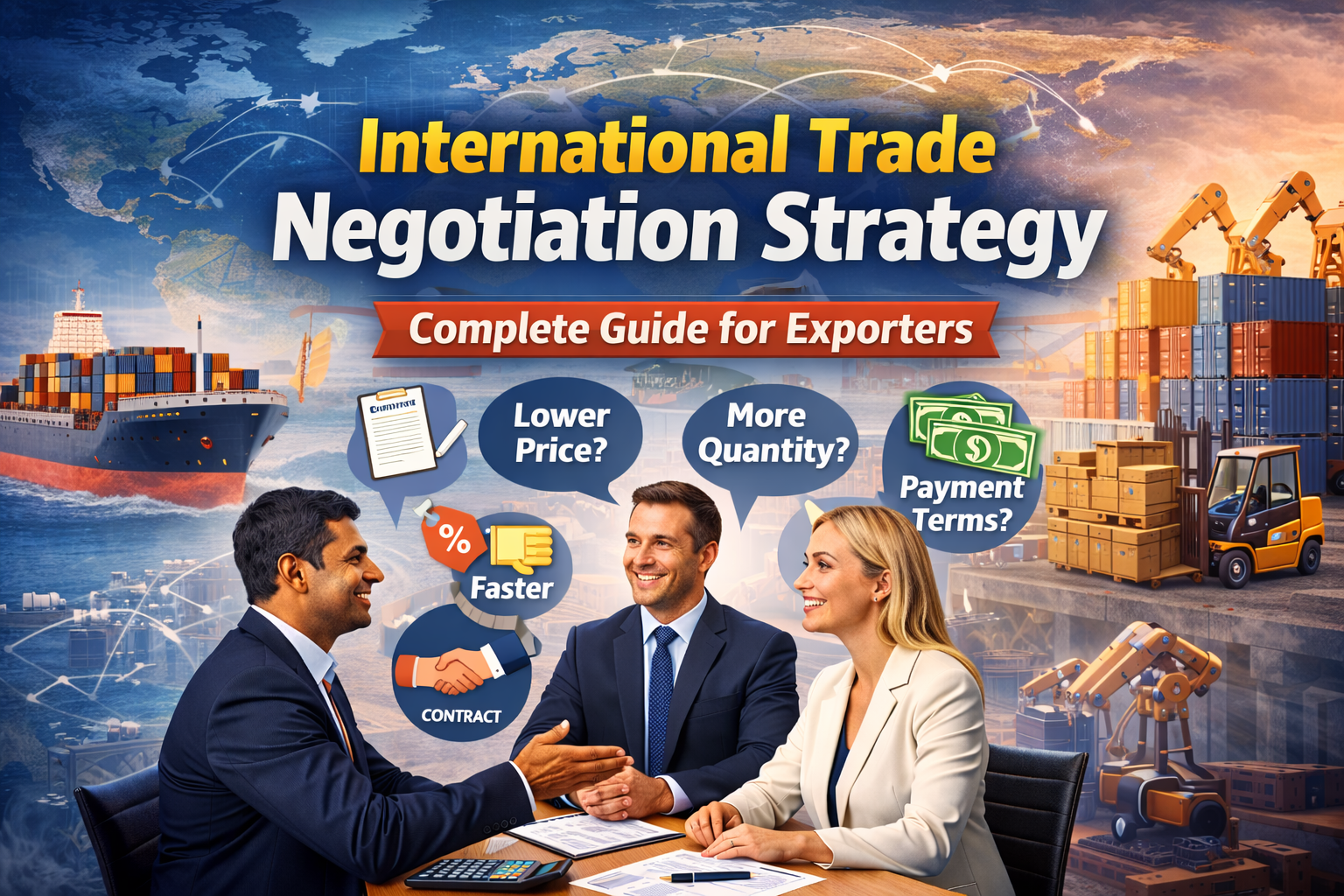
International Trade Negotiation Strategy – Complete Guide for Exporters
Learn the best international trade negotiation strategy for exporters. Discover how to negotiate price, payment terms, MOQ, and close profitable export deals with global buyers.
Admin
April 13, 2026
International Trade Negotiation Strategy – Complete Guide for Exporters
Winning in export business is not only about having a good product.Many exporters believe that if their quality is good and pricing is competitive, buyers will automatically place orders. But in reality, international trade is highly competitive, and most deals are won or lost during negotiation.
A buyer may ask for lower prices, longer payment terms, faster delivery, free samples, exclusive rights, or additional discounts. If you do not know how to negotiate properly, you may lose profits—or even lose the deal completely.
This is why every exporter must understand the right export negotiation strategy.
Strong negotiation skills can help you:
- Get better pricing
- Protect your profit margins
- Build trust with international buyers
- Handle objections confidently
- Close long-term export deals
In this guide, you will learn:
- What export negotiation strategy means
- Common mistakes exporters make
- International trade negotiation tips
- How to handle price pressure from buyers
- How to negotiate payment, MOQ, and delivery terms
- Why practical export training is important
What is an Export Negotiation Strategy?
Export negotiation strategy is the process of discussing prices, payment terms, delivery schedules, order quantity, product specifications, and other business conditions with international buyers.The goal is not just to close the deal.
The goal is to close a deal that is profitable, sustainable, and beneficial for both sides.
In export business, negotiation usually happens through:
- Emails
- Video calls
- WhatsApp or chat
- Trade fairs
- Face-to-face meetings
Why Negotiation is Important in Export Business
International buyers are experienced. They often compare multiple suppliers from different countries before making a decision.If you are not prepared, buyers may:
- Ask for unrealistic discounts
- Delay payments
- Demand free products
- Negotiate aggressively
- Compare your price with cheaper suppliers
Benefits of Good Negotiation
- Higher profit margins
- Better payment terms
- Stronger buyer relationships
- Fewer misunderstandings
- Increased chances of repeat orders
Common Mistakes Exporters Make During Negotiation
Many exporters lose deals or reduce their profit because they make avoidable mistakes.1. Quoting Very Low Prices Too Quickly
Some exporters think the only way to win buyers is by giving the lowest price.This is dangerous because:
- Your margins reduce
- Buyers expect even lower prices later
- You appear desperate
2. Not Understanding Buyer Requirements
Many exporters start negotiating without fully understanding what the buyer wants.Before discussing price, ask questions about:
- Quantity
- Product specifications
- Packaging needs
- Delivery timeline
- Target market
3. Giving Discounts Without Conditions
Never give a discount without getting something in return.For example:
- Discount in exchange for higher quantity
- Discount for advance payment
- Discount for long-term order commitment
4. Accepting Risky Payment Terms
Some exporters agree to open credit or delayed payment just to secure the order.This creates payment risk.
Always negotiate safer payment terms like:
- Advance payment
- Letter of Credit (LC)
- Partial advance with balance before shipment
5. Talking Too Much
Sometimes exporters reveal too much information during negotiation.Avoid discussing:
- Your desperation for orders
- Your lowest possible margin
- Internal business problems
Best Export Negotiation Strategy for International Buyers
Build Trust Before Negotiating
International buyers prefer working with exporters they trust.Before discussing pricing, build confidence by showing:
- Product images
- Certifications
- Company profile
- Factory details
- Export experience
- Buyer references
Always Know Your Minimum Acceptable Price
Before entering any discussion, calculate:- Product cost
- Packaging cost
- Shipping cost
- Margin requirement
Without this calculation, you may accept orders that are not profitable.
Focus on Value, Not Only Price
Many buyers ask, “Can you reduce the price?”Instead of immediately reducing your rate, explain:
- Better quality
- Strong packaging
- Faster production
- Product customization
- Better communication
- Lower defect rate
Use Quantity-Based Negotiation
A smart exporter uses quantity to negotiate better.For example:
- Small quantity = Standard price
- Medium quantity = Slight discount
- Large quantity = Better pricing
Negotiate Payment Terms Carefully
Payment is one of the most important parts of export buyer negotiation.For new buyers, safer payment terms are recommended:
- 100% advance for small orders
- 50% advance and 50% before shipment
- Letter of Credit for large orders
Discuss Delivery Time Clearly
Never promise unrealistic delivery timelines.Late delivery can damage buyer trust.
Instead:
- Give realistic timelines
- Include buffer time
- Inform buyers early about delays
International Trade Negotiation Tips
Here are some powerful international trade negotiation tips that can help exporters win better deals.Research the Buyer Before Negotiation
Understand:- Buyer company background
- Market reputation
- Country demand
- Import history
Stay Calm and Professional
Even if the buyer negotiates aggressively, remain polite and professional.Never Rush to Say Yes
Take time to review the buyer’s proposal before accepting.Use Silence Smartly
Sometimes silence creates pressure and encourages the buyer to improve their offer.Confirm Everything in Writing
Always keep records of:- Final price
- Quantity
- Payment terms
- Delivery schedule
How to Negotiate with Buyers Asking for Very Low Prices
This is one of the most common challenges in export business.When buyers say:
“Your price is too high.”
Do not panic.
You can respond professionally:
- Explain product quality
- Highlight packaging and finishing
- Offer different material options
- Suggest larger order quantity for better pricing
- Ask about their target price and reason
Negotiating MOQ in Export Business
MOQ means Minimum Order Quantity.Some buyers want very small quantities, while exporters want larger orders.
To negotiate MOQ:
- Explain production cost impact
- Offer trial orders at a slightly higher price
- Give better pricing for higher quantity
- Use MOQ to protect profitability
Export Import Course in Ahmedabad
Ahmedabad is one of India’s leading business cities with strong industries in textiles, chemicals, engineering, handicrafts, and manufacturing.This makes Ahmedabad an ideal city to learn export-import.
Why Ahmedabad Students and Entrepreneurs Should Learn Export Import
1. Huge Business Opportunities
Ahmedabad has thousands of manufacturers who want to export their products globally.2. High Demand for Skilled Professionals
Companies need trained people who understand negotiation, documentation, logistics, and buyer handling.3. Opportunity to Start Your Own Business
Students and entrepreneurs in Ahmedabad can build their own export business with the right guidance.4. Strong International Market Potential
Products from Gujarat already have demand worldwide.5. Better Income and Career Growth
Export-import provides better growth opportunities than many traditional jobs.If you are in Ahmedabad, learning export-import can open doors to international business and high-paying career opportunities.
Why Practical Export Training Matters
Most people know theory but fail during real buyer conversations.This is because export business is practical.
You must know:
- How to negotiate with buyers
- How to handle objections
- How to quote prices
- How to discuss payment terms
- How to close export deals
Why GIFT Export Import Training is Different
Most export-import courses only focus on theory.But real success comes from practical execution.
The GIFT Export Import Training Program is designed to help students, entrepreneurs, and job seekers learn export business practically.
What You Learn:
- Export negotiation strategy
- Buyer communication
- Product pricing
- Payment terms
- Documentation
- International logistics
- Business setup
You can explore the training program here:
Join GIFT Export Import Training
Frequently Asked Questions (FAQs)
1. What is an export negotiation strategy?
Export negotiation strategy is the process of discussing pricing, payment, delivery, quantity, and other terms with international buyers.2. How do exporters negotiate prices with buyers?
Exporters negotiate by explaining product quality, offering quantity-based discounts, and focusing on value instead of only price.3. What are the best payment terms in export business?
The safest payment terms include advance payment, partial advance, and Letter of Credit.4. How can I handle buyers asking for very low prices?
You should explain your product value, offer alternative options, and give discounts only in exchange for higher quantity or advance payment.5. Why is negotiation important in international trade?
Negotiation helps exporters protect their profit margins, avoid risky terms, and build strong buyer relationships.Conclusion
Export negotiation is one of the most important skills in international trade.A good exporter knows how to:
- Protect margins
- Handle price pressure
- Negotiate payment terms
- Build trust with buyers
- Close profitable long-term deals
Strong Call To Action
If you want to learn how to negotiate with international buyers confidently and build a successful export business, join the GIFT Export Import Course in Ahmedabad.This is a 100% practical training program where you will learn:
- Buyer negotiation
- Export pricing
- Documentation
- Payment terms
- International trade process
- Real export business strategies
Tags
#export