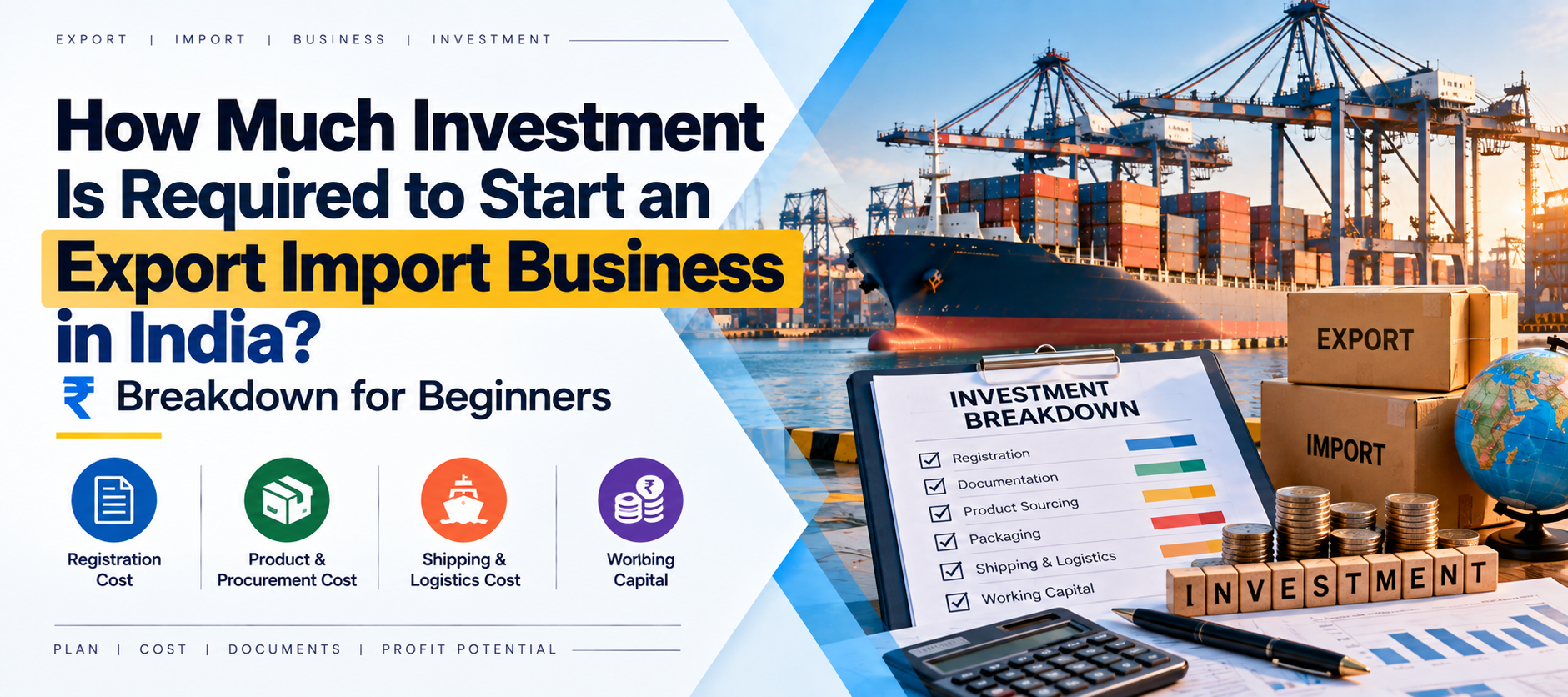
How Much Investment Is Required to Start an Export Import Business in India? ₹ Breakdown for Beginners
How much money do you need to start an export business in India? Understand startup costs, IEC, GST, product sourcing, packaging, marketing, shipping, and working capital — with a practical ₹ breakdown for beginners.
"How much money do I need to start an export business?"
The answer is: there is no single fixed investment amount.Your required investment depends on your business model, product, target country, inventory, order size, packaging, shipping method, and whether you manufacture, trade, or source products from suppliers.
You can start an export business in India with a relatively small amount if you begin with a low-inventory or merchant-export model. On the other hand, manufacturing, maintaining stock, and handling large export orders can require significantly higher working capital.
For a beginner, the important thing is not simply having a large budget — it is understanding where the money goes and avoiding unnecessary expenses.
---
How Much Investment Is Required for an Export Business?
A beginner can broadly divide the initial investment into these categories:| Expense | Approximate Beginner Budget |
|---|---|
| Business setup and registrations | ₹5,000 – ₹15,000+ |
| IEC-related and compliance expenses | Varies |
| Product samples | ₹5,000 – ₹20,000 |
| Product sourcing | ₹10,000 – ₹50,000+ |
| Packaging and branding | ₹5,000 – ₹20,000 |
| Website / catalogue | ₹0 – ₹25,000+ |
| International marketing | ₹5,000 – ₹25,000+ |
| Buyer finding / lead generation | ₹0 – ₹25,000+ |
| Logistics / sample shipping | ₹5,000 – ₹30,000+ |
| Working capital | ₹25,000 – ₹2,00,000+ |
These are illustrative planning ranges, not government-fixed fees or guaranteed costs. Actual expenses vary according to the business model and service providers.
For many beginners, a practical starting budget could be somewhere around ₹50,000 – ₹2 lakh, while some businesses can start with less and inventory-heavy businesses may require considerably more.---
1. Business Registration & Basic Setup
Before starting an export business in India, you need the appropriate business structure and registrations. Depending on your structure, you may consider:- Proprietorship, Partnership, LLP, or Private Limited Company
- PAN and Current Account
- GST registration (where applicable)
- Import Export Code (IEC)
- Udyam / MSME registration (where applicable)
Beginner tip: Do not spend a large amount on office infrastructure at the beginning unless your business actually requires it. Focus first on: Product + Buyer Finding + Sales + Documentation + Execution.
---2. How Much Does IEC Cost?
The Import Export Code (IEC) is a key requirement for businesses undertaking import/export activities, subject to applicable rules and exemptions.Beginners should distinguish between the government fee and consultancy or service charges. If you apply yourself, the government fee structure may be different from what a consultant charges for assisting with the application.
GIFT includes practical application of GST + IEC + MSME as part of its curriculum. The official GIFT page also currently lists a free IEC benefit subject to its terms.
---3. Product Cost: Your Biggest Variable
Your product is usually one of the biggest components of export business investment. There are three common approaches:A. Merchant Exporter
You purchase products from Indian manufacturers or suppliers and export them.Example:
- Product cost: ₹500 per unit
- Quantity: 100 units
- Inventory cost = ₹50,000
B. Manufacturer Exporter
You manufacture the product yourself. Your investment may include raw materials, machinery, labour, factory expenses, packaging, and inventory. The initial investment can therefore be much higher.C. Made-to-Order Exporting
Instead of maintaining large inventory, you manufacture or source products after receiving an order. This can reduce the amount of money blocked in inventory, depending on your supplier and buyer payment terms.---
4. Product Samples
Before placing a bulk order, an international buyer may request samples. Your sample budget can include product cost, customization, packaging, domestic transportation, international courier, and documentation.Example:
| Sample Expense | Amount ||---|---|
| Product cost | ₹3,000 |
| Packaging | ₹500 |
| International courier | ₹5,000 |
| Other expenses | ₹500 |
| Approximate sample cost | ₹9,000 |
This is why beginners should always include a sample budget when planning an export business.
---5. Packaging & Branding Investment
International buyers may have specific requirements for product packaging, carton specifications, labels, barcodes, product information, shipping marks, and branding.A beginner could initially budget around ₹5,000 – ₹20,000 for basic packaging development, product labels, catalogues, and branding — depending on the product.
For large shipments, packaging costs can become a significant part of export costing.
---6. Website & Product Catalogue
Do you need an expensive website to start exporting? Not necessarily.A beginner can initially use:
- A simple website or digital product catalogue
- LinkedIn and email
- B2B marketplaces and social media
- Direct buyer outreach
You can increase your digital investment as your business grows.
---7. International Buyer Finding Cost
One of the most important investments in an export business is not infrastructure — it is buyer acquisition. You may find international buyers through:- LinkedIn, Google, and B2B marketplaces
- Trade directories and trade fairs
- Export promotion councils and importer databases
- Direct email outreach, social media, and international digital marketing
GIFT specifically teaches 20+ methods for finding international buyers and suppliers, along with international digital marketing and buyer communication processes.
---8. Export Marketing Budget
You do not necessarily need ₹1 lakh to market your export business. A beginner could start with a small monthly marketing budget:| Marketing Activity | Example Budget |
|---|---|
| LinkedIn | ₹0 – ₹5,000 |
| Email marketing | ₹0 – ₹3,000 |
| Product catalogue | ₹1,000 – ₹5,000 |
| Digital advertising | ₹5,000 – ₹15,000 |
| B2B platforms | Depends on platform |
The objective should be to identify which channel generates genuine international enquiries before increasing spending.
---9. Shipping & Logistics Investment
Shipping costs vary significantly according to product, weight, volume, destination, air or sea freight, LCL or FCL, Incoterm, packaging, port, and freight rates.For a small sample, international courier may cost a few thousand rupees. For commercial shipments, costs can include:
- Freight and customs clearance
- Port charges and documentation
- Transportation, handling charges, and insurance (where applicable)
This is why export costing is an essential skill for every exporter.
---10. Working Capital: The Most Important Part
Many beginners calculate only the cost of starting the company. They forget working capital.Suppose you receive an order worth ₹2,00,000. You may need money for raw materials, production, packaging, labour, transportation, documentation, and logistics — before receiving complete payment from the buyer.
Example:
| Detail | Amount ||---|---|
| Export order value | ₹5,00,000 |
| Total product and execution cost | ₹3,50,000 |
| Buyer advance (30%) | ₹1,50,000 |
| Additional funds needed | ₹2,00,000 |
Payment terms directly affect the amount of working capital required. This is why understanding payment terms is as important as understanding export costs.
---Real-World Example: Starting an Export Business With ₹1 Lakh
Consider a hypothetical beginner named Rahul who wants to export Indian home décor products. Instead of manufacturing everything himself, he works with domestic suppliers and follows a merchant-export model.His initial budget could look like:
| Expense | Approx. Amount |
|---|---|
| Business setup and professional assistance | ₹10,000 |
| Product samples | ₹15,000 |
| Packaging and catalogue | ₹10,000 |
| Website / basic digital presence | ₹10,000 |
| Buyer research and marketing | ₹15,000 |
| Sample shipping | ₹10,000 |
| Initial working capital | ₹30,000 |
| Total | ₹1,00,000 |
Rahul does not purchase ₹5 lakh of inventory on Day 1. Instead, he follows this approach:
Find product → Identify buyers → Send samples → Negotiate → Receive order → Arrange production → Ship
The actual cash requirement depends on the supplier's payment terms, buyer's payment terms, and order structure.
---Can You Start an Export Business With ₹50,000?
Possibly — depending on the business model. A low-cost approach could involve:- No physical office
- Made-to-order products and domestic supplier network
- Digital catalogue and organic LinkedIn marketing
- Direct email outreach and small product samples
- Buyer-funded production through suitable payment terms
---
Where Should Beginners NOT Overspend?
If you are starting an export-import business for the first time, avoid spending heavily before validating demand:- Expensive office before you have buyers
- Large inventory without confirmed orders
- Too many paid portals at once
- Expensive branding before product validation
- Large advertising campaigns without testing
- Multiple product categories at once
Instead, focus on:
Product Selection → Target Market → Buyer Finding → Communication → Sample → Order → Execution---
How GIFT Training Helps You Understand Export Business Investment
One of the biggest challenges for beginners is not simply finding money — it is knowing where money should be invested and how export costs should be calculated.The GIFT – Global International Foreign Trade Program by 10X Exports is a 45-day, 100% offline and practical export-import training program covering 250+ topics across 18 modules. GIFT covers areas directly connected with export business investment:
1. Selection of Profitable Products
Choosing the right product can influence your investment, margins, and working capital requirements.2. Export Costing
Understanding costs is essential before quoting an international buyer:Product Cost + Packaging + Inland Transport + Documentation + Freight + Other Applicable Charges = Export Cost
3. International Buyer Finding
GIFT teaches 20+ buyer and supplier finding methods — helping students develop international leads rather than spending blindly on marketing.4. Payment Safety
Payment terms affect working capital and financial risk. GIFT includes training on safeguarding international payments.5. Shipping & Logistics
Freight and logistics can significantly affect your final export price. GIFT covers container booking, charge analysis, customs clearance, documentation, shipping, and logistics.6. Starting Your Own Business While Learning
GIFT specifically highlights making your own business simultaneously and executing export-import processes while learning.GIFT Program Benefits for Aspiring Exporters
The official GIFT page currently lists several program benefits, including:- Free buyer data (subject to terms)
- Free IEC (subject to terms)
- Free supplier data and first trade support
- Study material and 10X Exports network connection
- Customized planning and strategy
- Port visit and job/internship company suggestions
- Entrepreneur networking and lifetime support
- GIFT certificate
---
Beginner Export Business Investment: A Simple Formula
Instead of asking "How much money do I need to start exporting?" — ask: "How much money does my specific export model require?"Startup Investment
Registration + Samples + Marketing + Catalogue + Initial SetupWorking Capital
Product Cost + Packaging + Production + Transportation + LogisticsRisk Buffer
Unexpected Costs + Delays + Sample Replacements + Price ChangesYour total requirement is the combination of these three areas.
Conclusion
Starting an export business in India does not necessarily require a huge investment. A beginner can potentially start with a relatively lean model by choosing the right product, avoiding unnecessary inventory, working with reliable suppliers, finding buyers before scaling, understanding export costing, and controlling logistics costs.The biggest mistake is thinking that investment means only money. In international trade, knowledge is also an investment.
Understanding product selection, international buyer finding, export documentation, costing, payment safety, customs, shipping, and logistics can help you make better financial decisions — and avoid expensive mistakes.Call To Action
The GIFT Program by 10X Exports focuses on these practical areas through a 45-day, 100% offline training program covering 250+ topics across 18 modules — with live projects, case studies, buyer communication, industry exposure, and practical export-import activities.👉 Join GIFT Export Import Course in Ahmedabad
India's most practical export training — for students, beginners, and entrepreneurs.
🚀 Understand the costs. Plan the investment. Start your export business the right way.
Tags
Frequently Asked Questions
How much money is required to start an export business in India?
There is no fixed amount. A beginner can potentially start with ₹50,000 – ₹1 lakh using a lean, low-inventory or merchant-export model. Inventory-heavy or manufacturing businesses may require several lakhs. The right amount depends on your product, business model, order size, and payment terms.
Can I start an export business in India with ₹1 lakh?
Yes, depending on the product and business model. A merchant-export or made-to-order model requires less upfront inventory. The key is choosing the right product, finding buyers early, keeping startup expenses lean, and scaling only after receiving your first confirmed order.
What are the main costs of starting an export business in India?
Major costs include business setup and registrations, product samples, sourcing or production, packaging and branding, international marketing, buyer acquisition, documentation, shipping and logistics, and working capital. The proportion of each depends on your product, business model, and order size.
What is working capital and why does it matter in export business?
Working capital is the money you need to fund production, packaging, transportation, and logistics before receiving payment from the buyer. If your buyer pays 30% in advance and the rest on delivery, you need to arrange the remaining 70% of production costs yourself. This is why payment terms directly affect how much working capital you need.
Where should beginners avoid overspending when starting an export business?
Beginners should avoid spending heavily on an expensive office before getting buyers, large inventory without confirmed orders, too many paid portals at once, expensive branding before product validation, and multiple product categories at the start. Focus first on product selection, buyer finding, and getting your first order — then scale.