Export Payment Terms: LC, DA, DP and Advance Payment — Which Is Safest for a New Exporter?
Getting paid safely is one of the biggest concerns for new exporters. Learn how LC, DA, DP, and advance payment work — their risks, benefits, and which payment term is safest for your export business in India.
Export Payment Terms: LC, DA, DP and Advance Payment — Which Is Safest for a New Exporter?
One of the biggest concerns for a beginner in the export-import business is getting paid by international buyers.You may find a genuine buyer, negotiate a good price, and ship the goods successfully. But what happens if the buyer delays payment or refuses to pay?
This is why understanding export payment terms, international trade payments, and payment risk management is essential before accepting an export order.
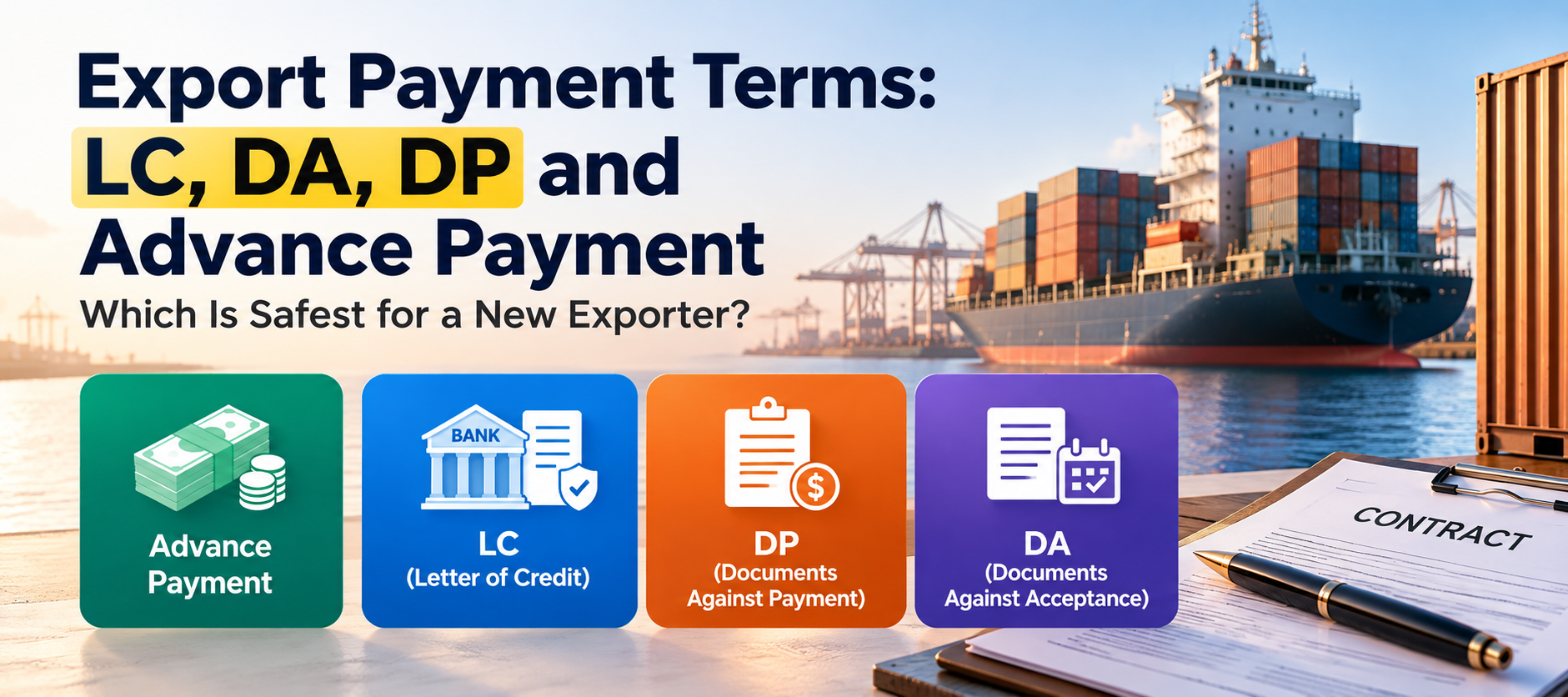
The four common payment terms are:
- Advance Payment — The buyer pays before shipment
- LC (Letter of Credit) — A bank undertakes to pay if the exporter presents documents that comply with the LC terms
- DP (Documents Against Payment) — The buyer receives the shipping documents against payment
- DA (Documents Against Acceptance) — The buyer receives the documents after accepting a payment obligation for a future date
For a new exporter, advance payment is generally the safest option for the seller, while a properly structured Letter of Credit can provide a useful balance between buyer confidence and payment security. However, no payment method removes every risk.
---1. What Is Advance Payment in Export?
Advance payment means the international buyer pays the exporter before the goods are shipped. Payment may be 100% in advance or a mutually agreed percentage before production or shipment.Example:
An Indian exporter receives an order worth ₹5,00,000 from a buyer in the UAE. The agreed payment term is 100% advance. The buyer transfers ₹5,00,000 before the exporter dispatches the goods, subject to the agreed contract and applicable banking requirements.Advantages of Advance Payment
- Lowest buyer non-payment risk for the exporter once the funds are received and verified
- Helps finance production and product procurement
- Reduces the need to fund the entire order from working capital
- Useful for first-time buyers and customized products
Disadvantages of Advance Payment
- New international buyers may hesitate to pay before receiving goods
- Buyers may prefer competitors offering credit terms
- Refunds or disputes may arise if the exporter cannot fulfil the order
Is Advance Payment Safe for New Exporters? Yes — from the exporter's payment-risk perspective, it is generally the safest option. However, confirm that the funds have actually reached your bank account. Do not rely only on screenshots or payment confirmation messages.
---2. What Is LC (Letter of Credit)?
A Letter of Credit (LC) is a payment undertaking issued by a bank on behalf of the buyer. The bank agrees to pay the exporter when the exporter presents the documents required by the LC and those documents comply with its terms.An LC can be useful when the exporter and buyer have not yet developed a strong trading relationship.
Example:
An Indian exporter receives a USD 20,000 order from a new buyer in Germany. The buyer arranges an LC through its bank. The exporter checks the LC conditions, ships the goods, and submits the required documents through the banking channel. If the documents comply with the LC requirements, the issuing bank is obligated to honour the credit according to its terms.Advantages of LC
- Provides a bank-backed payment undertaking, subject to LC conditions
- Can increase confidence when dealing with a new buyer
- Helps define the documents and conditions required for payment
- May reduce dependence on the buyer's willingness to pay after shipment
Disadvantages of LC
- Bank charges and document-handling costs may apply
- Documentation must strictly comply with the LC
- Discrepancies can delay payment or lead to a refusal to honour the presentation
- The issuing bank's creditworthiness, country risk, and LC terms still matter
Is LC Safe for New Exporters? An LC can be a strong option for a new exporter, particularly for a sizeable order. However, the exporter should ask their bank or trade-finance specialist to review the LC before accepting it. Important: A Letter of Credit is not an unconditional guarantee of payment — payment depends on complying with the LC's documentary requirements and applicable terms.
---3. What Is DP (Documents Against Payment)?
DP stands for Documents Against Payment. It is a documentary collection method in which the buyer is generally required to pay before the collecting bank releases the shipping documents. The banks facilitate the collection but do not ordinarily guarantee that the buyer will pay.Example:
An Indian exporter ships handicraft products to a buyer in the UAE under DP terms. The shipping documents are sent through the banking channel for collection. The buyer pays the amount due, and the documents are released according to the collection instructions.Advantages of DP
- The buyer normally needs to pay before obtaining the documents required to take delivery
- It can be simpler and less expensive than some LC arrangements
- It may be suitable for buyers with a credible trading history
Disadvantages of DP
- The buyer may refuse to pay when the goods arrive
- Goods may remain at the destination port, creating storage, demurrage, or other costs
- Banks do not guarantee payment merely because they handle the documents
- The exporter may need to arrange return, resale, or other disposal of the goods
Is DP Safe for New Exporters? DP can offer more protection than DA in terms of document release, but it is not payment-guaranteed. For a first transaction, consider DP only after evaluating the buyer, destination-country risks, product resale potential, and the consequences of non-payment.
---4. What Is DA (Documents Against Acceptance)?
DA stands for Documents Against Acceptance. Under this arrangement, the buyer accepts a draft or payment obligation for a specified future date and receives the documents according to the collection instructions. The buyer generally pays later, rather than at the time the documents are released.Example:
An Indian exporter sends products worth ₹8,00,000 to an overseas buyer under DA 60 days. The buyer accepts the payment obligation and receives the documents. Payment is due 60 days later. If the buyer fails to pay on the due date, the exporter may have to pursue recovery while the goods have already been released.Advantages of DA
- Offers payment flexibility to the buyer
- Can help an established exporter maintain long-term customer relationships
- May make the exporter more competitive when buyers expect credit terms
Disadvantages of DA
- The buyer can receive the documents before making payment
- The exporter carries significant non-payment risk
- Late payment can create cash-flow problems
- Recovering money from an overseas buyer may be costly and complicated
Is DA Safe for New Exporters? DA is generally riskier for a new exporter than advance payment, a compliant LC, or DP. Avoid offering DA terms to an unfamiliar buyer simply to secure an order. Consider credit checks, suitable trade credit insurance, and professional advice before agreeing to deferred payment.
---5. LC vs DA vs DP vs Advance Payment: Comparison
| Payment Term | When Does the Buyer Pay? | Exporter's Payment Risk | Suitability for Beginners ||---|---|---|---|
| Advance Payment | Before shipment | Lowest buyer non-payment risk once funds are received | Generally the safest |
| LC | According to compliant presentation and LC terms | Lower when the LC is sound and documents comply | Strong option with expert review |
| DP | Before shipping documents are released | Moderate — buyer may refuse payment | Use after risk assessment |
| DA | At a future agreed date | High — buyer may not pay later | Generally avoid with unknown buyers |
This is a general comparison, not a guarantee of outcomes. The buyer's creditworthiness, country risk, contract terms, product type, and banking arrangements all affect the actual risk.
---6. Which Export Payment Term Is Safest for a New Exporter?
For most new exporters, a sensible general order of preference is:- Advance Payment — Safest against buyer non-payment once the funds are received
- LC — Can provide strong protection when issued by an acceptable bank and correctly structured
- DP — The buyer pays before receiving the shipping documents, but may refuse payment
- DA — Higher risk because the buyer can receive the documents before the payment falls due
Recommended Approach for Beginners
- Prefer full advance payment when commercially realistic
- If the buyer will not agree, negotiate a reasonable advance plus a carefully structured balance payment
- Consider an LC for larger orders, after having the terms reviewed by your bank
- Use DP only after evaluating the buyer and shipment risks
- Avoid DA or open-account terms with an unverified buyer unless suitable credit protection is in place
A new exporter should not select payment terms based only on what the buyer requests. The terms must also protect the exporter's cash flow.
---7. Real-World Example: Choosing Payment Terms for a First Export Order
Consider a hypothetical Indian exporter named Rahul who sells wooden handicrafts. He receives an order worth ₹6,00,000 from a buyer in Europe. This is their first transaction.The buyer offers three options:
- Option A: 100% advance payment
- Option B: Letter of Credit
- Option C: DA 60 days
Rahul evaluates the choices:
Option A — Advance Payment: Rahul receives the agreed amount before shipment. This reduces his exposure to buyer non-payment, although he must still fulfil the order and comply with the contract.Option B — LC: Rahul asks his bank to review the LC, including the issuing bank, payment conditions, document list, and presentation deadlines. If the terms are acceptable and he can comply with them, the LC may be a suitable option.
Option C — DA 60 Days: Rahul ships the goods and the buyer receives the documents before the payment is due. If the buyer does not pay, Rahul may face a financial loss and difficulties recovering the amount.
For this first transaction, Rahul would generally prefer advance payment. If the buyer insists on another method, a properly reviewed LC may be worth considering. The lesson: a profitable-looking export order is not necessarily a safe order if the payment terms expose you to a loss you cannot afford.
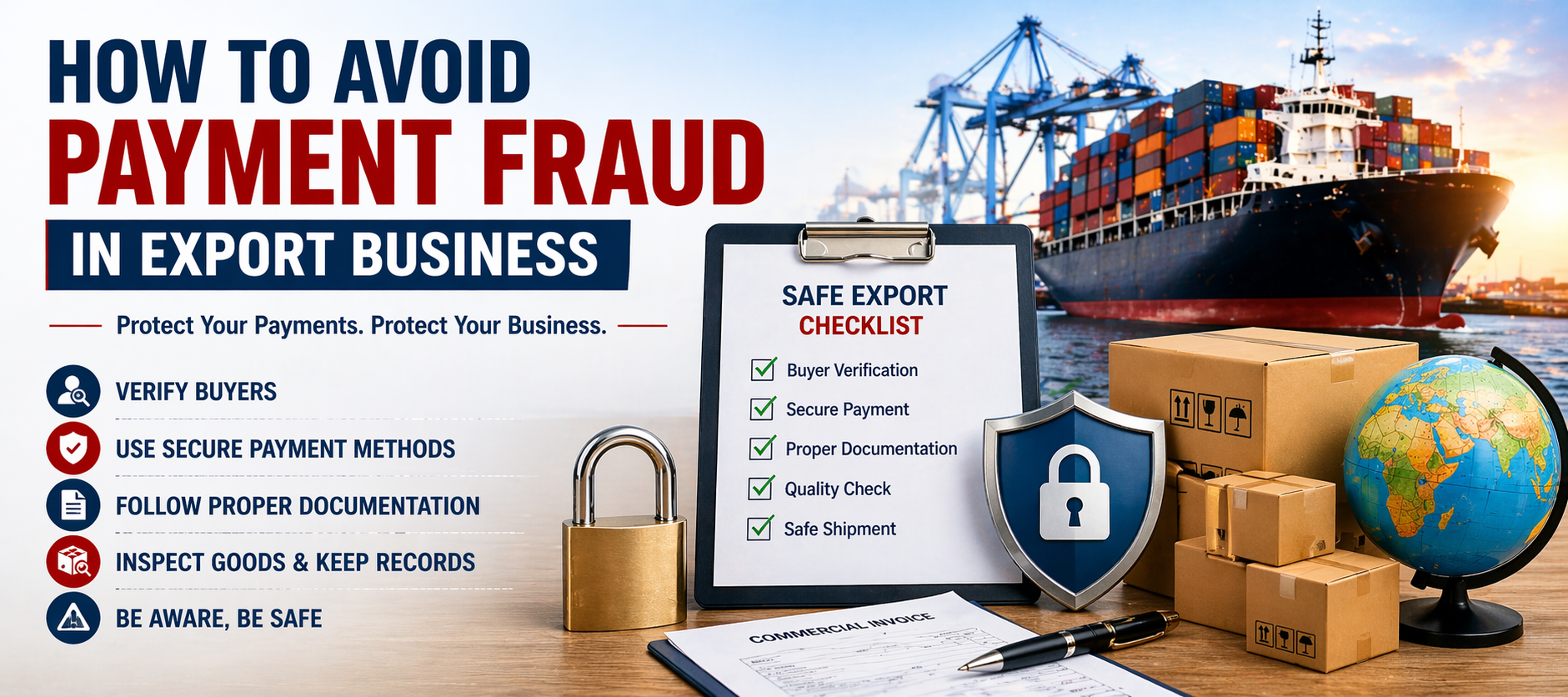
---8. How to Protect Yourself From Export Payment Fraud
Before accepting an international order, follow these precautions:Verify the Buyer
Check the company's registration, website, business history, address, references, and contact details.Confirm Payment Terms in Writing
Clearly state the currency, amount, payment deadline, bank charges, delivery conditions, and consequences of non-payment in the contract or purchase order.Check Bank Instructions Carefully
Verify bank details through a trusted channel. Treat unexpected requests to change bank accounts as a potential fraud warning.Review an LC Before Shipment
Have your bank check the issuing bank, expiry date, shipment deadline, documents required, and discrepancy provisions.Do Not Trust Payment Screenshots
Confirm receipt of funds directly with your bank before treating payment as completed.Consider Export Credit Insurance
For eligible transactions, ask the relevant insurer or financial institution about protection against commercial and political risks. Review the policy exclusions and conditions carefully.India's official export guidance recommends considering a credit limit on a foreign buyer through ECGC when an order is placed without advance payment or an LC.
---9. How GIFT Training Helps You Understand Export Payment Terms
The GIFT – Global International Foreign Trade Program by 10X Exports is a 45-day, 100% offline and practical export-import training program based in Ahmedabad. Its curriculum covers 250+ topics across 18 modules, with live case studies, buyer communication, industry visits, and sessions from exporters, Customs House Agents, and freight forwarders.1. Understanding International Payment Methods
Learn why advance payment, LC, DP, and DA have different risks and how payment conditions affect export transactions.2. Buyer Verification and Communication
GIFT covers international buyer finding and communication — helping students evaluate business enquiries before proceeding with an order.3. Export Documentation
Payment arrangements often depend on invoices, transport documents, and other paperwork. Practical documentation knowledge helps exporters understand the importance of accuracy.4. Export Costing and Cash Flow
Payment timing affects working capital. Understanding export costing, freight, and other charges helps beginners plan their finances more carefully.5. Practical Case Studies and Industry Exposure
GIFT highlights live case studies and practical export-import activities — helping learners connect classroom knowledge with real business situations.👉 Explore the Official GIFT Export Import Training Program
Conclusion
Choosing the right export payment terms is essential for building a sustainable export business in India.- Advance Payment — Generally the safest against buyer non-payment for the exporter
- LC — Can provide strong payment protection when the bank, terms, and documents are carefully checked
- DP — Requires payment before the shipping documents are released, but the buyer can still refuse payment
- DA — Allows the buyer to pay later and exposes the exporter to greater credit risk
Remember: finding an international buyer is only one part of exporting. Receiving payment safely is equally important.
Call To Action
The GIFT Program by 10X Exports helps learners build practical knowledge of export-import processes, buyer communication, documentation, logistics, and payment safety — through a 45-day, 100% offline and practical training program.👉 Join GIFT Export Import Course
India's most practical export training — for students, beginners, and entrepreneurs.
🚀 Understand payment terms. Protect your money. Export with confidence.
Tags
Frequently Asked Questions
Which export payment term is safest for a new exporter in India?
Advance payment is generally the safest because the exporter receives funds before shipment — eliminating buyer non-payment risk once the funds are verified in the bank. For larger orders, a properly reviewed Letter of Credit from an acceptable bank can also provide strong protection.
What is the difference between LC, DP, and DA in export?
Under LC, a bank undertakes to pay against a compliant document presentation. Under DP, the buyer must pay before receiving the shipping documents — but banks don't guarantee payment. Under DA, the buyer accepts a future payment obligation and receives the documents before paying — making it the riskiest for exporters.
Can a buyer refuse payment under DP terms in export?
Yes. Under DP terms, a buyer can refuse to pay, leaving goods stranded at the destination port with potential storage, demurrage, and return costs for the exporter. This is why buyer verification and destination-country risk assessment are important even under DP.
Does a Letter of Credit guarantee payment for the exporter?
An LC provides a bank payment undertaking subject to its specific terms and a compliant document presentation — it is not an unconditional guarantee. The quality of the issuing bank, country risk, document accuracy, and strict compliance with LC conditions all affect whether payment is received.
Is DA payment recommended for new Indian exporters?
No. DA is generally the riskiest option for new exporters because the buyer receives the shipping documents before making payment. If the buyer fails to pay on the due date, recovering money from an overseas buyer can be expensive and complicated. Avoid DA with unverified buyers unless suitable credit protection is in place.