General
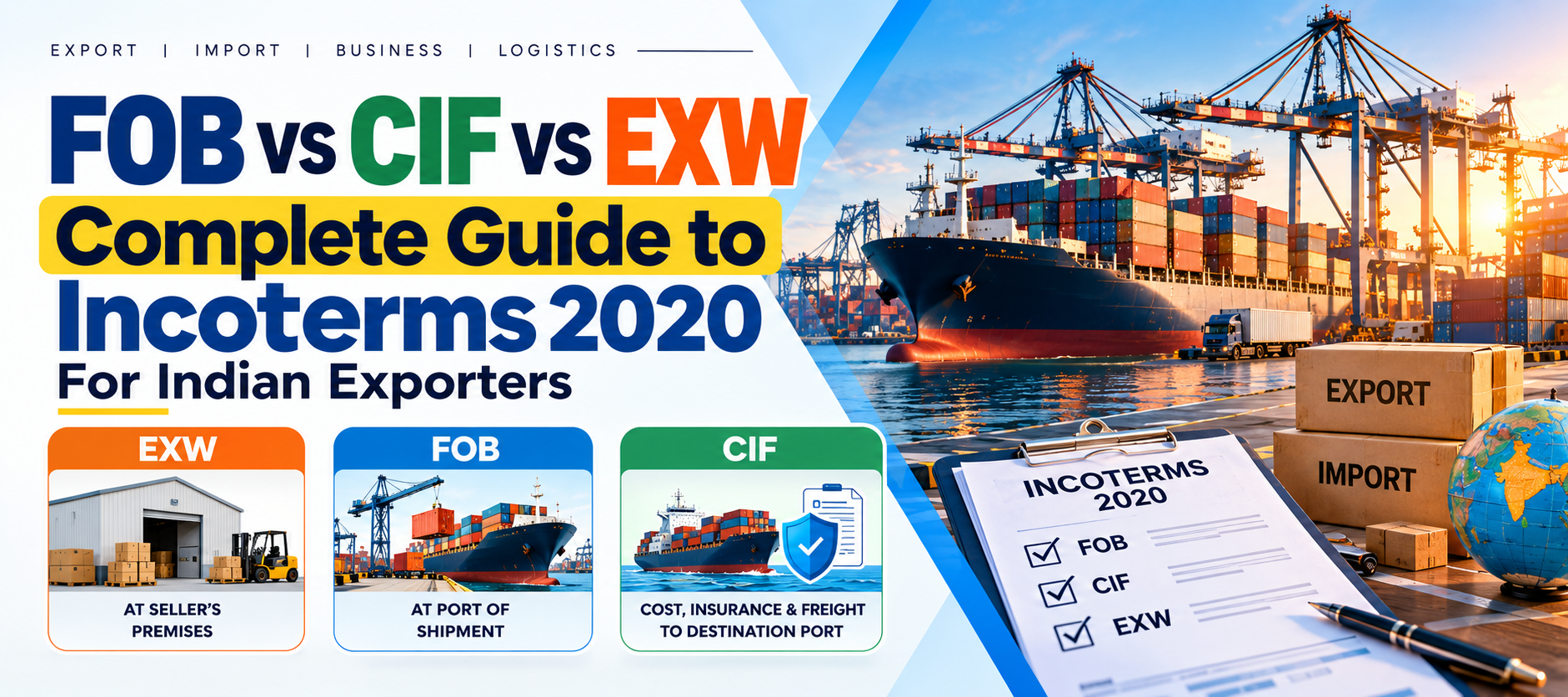
FOB vs CIF vs EXW: Complete Guide to Incoterms 2020 for Indian Exporters
Buyers ask for FOB price, CIF price, EXW price — but what do these actually mean? This complete guide to Incoterms 2020 explains EXW, FOB, CIF, FCA, DAP, DDP and more with real export costing examples, a responsibility matrix, and practical tips for Indian exporters.
Admin
October 3, 2026
FOB vs CIF vs EXW: Complete Guide to Incoterms 2020 for Indian Exporters
If you are starting an export business from India, you will frequently hear terms like EXW, FOB, CIF, CFR, FCA, DAP, and DDP.But what do these terms actually mean?
A buyer may ask: "Can you give me your FOB price?" Another buyer may say: "Please quote CIF." And sometimes a buyer may simply ask: "What is your EXW price?"
These are Incoterms — and understanding them is essential for export costing, international buyer communication, logistics, shipping, and export pricing.
Incoterms decide who is responsible for which costs, activities, and risks during the delivery of goods.
The current ICC edition is Incoterms® 2020, which contains 11 trade rules. ICC divides them into rules for any mode of transport and rules specifically for sea and inland waterway transport.---
What Are Incoterms in Export?
Incoterms = International Commercial Terms.They are standardized three-letter rules published by the International Chamber of Commerce (ICC). They help buyers and sellers understand:
- Who arranges transportation?
- Who pays freight?
- Who handles export clearance?
- Who handles import clearance?
- Who arranges insurance?
- Where does delivery take place?
- When does the risk transfer from seller to buyer?
For example:
| Incoterm | Price ||---|---|
| EXW Price | ₹4,00,000 |
| FOB Price | ₹4,80,000 |
| CIF Price | ₹5,45,000 |
The product has not changed. The responsibilities and included costs have changed.
---Incoterms 2020: All 11 Terms
The 11 Incoterms 2020 are divided into two groups:Rules for Any Mode of Transport
- EXW — Ex Works
- FCA — Free Carrier
- CPT — Carriage Paid To
- CIP — Carriage and Insurance Paid To
- DAP — Delivered at Place
- DPU — Delivered at Place Unloaded
- DDP — Delivered Duty Paid
Rules for Sea and Inland Waterway Transport
- FAS — Free Alongside Ship
- FOB — Free On Board
- CFR — Cost and Freight
- CIF — Cost, Insurance and Freight
For beginners, the three terms most commonly encountered are EXW, FOB, and CIF. Let's understand these in simple language.
---EXW — Ex Works
Under EXW, the seller makes the goods available to the buyer at the agreed location — such as the seller's factory or warehouse. The seller generally does not have to load the goods onto the buyer's collecting vehicle or clear them for export under the EXW rule.Example:
An Indian furniture manufacturer quotes:EXW Jodhpur — ₹4,000 per chair
This means the quoted price is based on the goods being made available at the agreed location in Jodhpur. The buyer generally takes responsibility for the subsequent transportation and other applicable activities.
EXW in simple words: "Goods are ready at my premises. You take it from here."
Important Point for Indian Exporters:
EXW may look simple because the seller has fewer delivery responsibilities. However, international transactions can create practical issues around export clearance and loading. ICC notes that exporters may consider FCA where appropriate instead of EXW, particularly when export procedures are involved.---
FOB — Free On Board
FOB is one of the most commonly used Incoterms for sea exports. Under FOB, the seller delivers the goods on board the vessel nominated by the buyer at the named port of shipment. The risk transfers to the buyer when the goods are on board the vessel.Example:
An Indian exporter quotes:FOB Nhava Sheva — USD 5,000
The exporter is responsible for getting the goods to the point required under the FOB rule and placing them on board the buyer-nominated vessel. After the goods are on board, the buyer bears the risk and subsequent costs.
FOB in simple words: "I will get the goods loaded on the ship — after that, it is the buyer's responsibility."
Important:
FOB is meant for sea or inland waterway transport where the goods are delivered by being placed on board a vessel. ICC specifically says FOB is not appropriate when goods are handed over to a carrier at a container terminal before being loaded on board — FCA may be more suitable in that situation.---
CIF — Cost, Insurance and Freight
Under CIF, the seller delivers the goods on board the vessel, pays the freight to the named destination port, and arranges the insurance required under the CIF rule.However, an important point is often misunderstood:
CIF does NOT mean the seller carries the risk until the goods reach the destination port. Under CIF, risk transfers when the goods are delivered on board the vessel at the port of shipment.
Example:
An Indian exporter quotes:CIF Melbourne — USD 8,000
The seller pays the applicable costs required under CIF, including the agreed freight and required insurance to the named destination port.
CIF in simple words: "I will load the goods on the ship and also arrange the main freight and required insurance."
---FOB vs CIF vs EXW: Quick Comparison
| Point | EXW | FOB | CIF ||---|---|---|---|
| Full Form | Ex Works | Free On Board | Cost, Insurance & Freight |
| Transport Mode | Any | Sea / Inland Waterway | Sea / Inland Waterway |
| Seller Delivery Point | Named place | On board vessel | On board vessel |
| Main Freight | Buyer | Buyer | Seller |
| Export Clearance | Buyer (under EXW) | Seller | Seller |
| Insurance | Buyer | Buyer | Seller |
| Import Clearance | Buyer | Buyer | Buyer |
| Risk Transfer | At agreed EXW delivery point | On board vessel | On board vessel |
| Destination Freight Included? | No | No | Yes |
This is a simplified practical comparison. The exact obligations depend on the selected Incoterm, named place/port, and contract.
---Incoterms Responsibility Matrix
| Responsibility | EXW | FOB | CIF ||---|---|---|---|
| Product Manufacturing | Seller | Seller | Seller |
| Product Packaging | Seller | Seller | Seller |
| Loading at Seller's Premises | Buyer | Seller | Seller |
| Export Clearance | Buyer (under EXW) | Seller | Seller |
| Inland Transport to Port | Buyer | Seller | Seller |
| Main Ocean Freight | Buyer | Buyer | Seller |
| Required Insurance | Buyer | Buyer | Seller |
| Delivery on Board Vessel | Buyer | Seller | Seller |
| Import Clearance | Buyer | Buyer | Buyer |
| Import Duties / Taxes | Buyer | Buyer | Buyer |
| Risk Transfer | At EXW delivery point | On board vessel | On board vessel |
---
Real Export Costing Example
Suppose an Indian exporter receives an order for 100 wooden chairs:| Cost Component | Amount |
|---|---|
| Product Cost (100 × ₹4,000) | ₹4,00,000 |
| Export Packaging | ₹20,000 |
| Inland Transportation | ₹25,000 |
| Export Clearance Costs | ₹15,000 |
| Applicable Port / Handling Costs | ₹20,000 |
| Ocean Freight | ₹60,000 |
| Insurance | ₹5,000 |
EXW Price:
Product cost = ₹4,00,000Quote: EXW Jodhpur = ₹4,00,000
FOB Price:
₹4,00,000 + ₹20,000 + ₹25,000 + ₹15,000 + ₹20,000 = ₹4,80,000Quote: FOB Nhava Sheva = ₹4,80,000
CIF Price:
₹4,80,000 + ₹60,000 + ₹5,000 = ₹5,45,000Quote: CIF destination port = ₹5,45,000
The same product has different export prices because different Incoterms include different costs and responsibilities. Never quote an export price without clearly mentioning the Incoterm and named place/port.
---Real-World Example: Indian Furniture Exporter
A furniture manufacturer in Jodhpur receives an inquiry from a buyer in Australia for 500 chairs. The buyer asks: "Please send your FOB price."The exporter calculates only the chair manufacturing cost and replies: USD 50 per chair FOB.
Later, the exporter discovers that packaging, inland transportation, export clearance, and applicable port costs were not included in the calculation. The order looks profitable on paper but becomes much less profitable after actual export costs are added.
What should the exporter do?
Before sending the quotation, calculate:Product Cost + Packaging + Inland Transportation + Export Clearance + Applicable Port Charges = FOB Cost
Then add the desired profit margin. If the buyer asks for CIF, additionally calculate the applicable ocean freight and required insurance.
This is why Incoterms and export costing must always be understood together.
---FOB vs CIF: What Is the Main Difference?
FOB:
- Seller gets goods on board the vessel
- Buyer arranges the main ocean freight
CIF:
- Seller gets goods on board + pays main freight + arranges required insurance
---
EXW vs FOB: What Is the Difference?
- EXW — Seller's responsibility ends much earlier, at the agreed place of delivery
- FOB — Seller has significantly more responsibility, delivering the goods on board the vessel at the named port
Lower responsibility does not automatically mean EXW is the best choice. Export clearance and operational realities should always be considered.
---What About FCA?
FCA – Free Carrier is an important Incoterm that beginners should know. FCA can be used for any mode of transport and is useful when goods are handed over to a carrier at an agreed location.ICC's guidance specifically recommends considering FCA for containerized or multimodal shipments where delivery takes place to a carrier or terminal rather than directly on board the vessel.
Do not use FOB automatically for every sea shipment. First understand how and where the goods are actually handed over.
---CFR vs CIF
Both are sea/inland-waterway Incoterms:CFR — Cost and Freight:
- Seller delivers goods on board and pays freight to destination port
- Buyer bears risk after delivery on board and arranges insurance
CIF — Cost, Insurance and Freight:
- Seller delivers goods on board, pays freight, and arranges the insurance required under CIF
CFR = Freight included. CIF = Freight + required insurance included.
---DAP vs DDP
DAP — Delivered at Place:
Seller brings goods to the named destination, ready for unloading. Import clearance and applicable import duties generally remain with the buyer.DDP — Delivered Duty Paid:
Seller takes on much broader responsibility, including import clearance and applicable duties/taxes. ICC describes DDP as the Incoterms rule imposing the maximum level of obligation on the seller.For a new exporter, DDP should not be quoted casually without understanding the destination country's import procedures, taxes, and compliance requirements.
---Which Incoterm Is Safe for a Beginner Exporter?
There is no single Incoterm that is automatically safest for every beginner. The right choice depends on:- Product and destination
- Transport mode and buyer requirements
- Exporter's logistics knowledge and freight arrangements
- Export clearance and import requirements
- Total order value and insurance
The better approach is always: First understand → then calculate → then quote.
---Common Incoterms Mistakes by New Exporters
Mistake 1: Giving a Quotation Without an Incoterm
Don't simply write: USD 5,000Write: USD 5,000 — FOB Nhava Sheva — Incoterms® 2020
Mistake 2: Confusing Risk With Cost
CIF does not mean the seller carries the risk until the destination. Risk transfers on board the vessel at the port of shipment.Mistake 3: Using FOB for Every Shipment
FOB is specifically a sea/inland-waterway rule. For containerized or multimodal transactions, FCA may be more appropriate depending on the delivery arrangement.Mistake 4: Forgetting Export Costs
Your FOB price should not be calculated by simply adding a profit margin to your manufacturing cost. Include all costs applicable to your seller obligations.Mistake 5: Confusing Incoterms With Payment Terms
This is a very common beginner mistake.- FOB / CIF / EXW = delivery terms
- Advance payment / LC / Open Account = payment terms
---
How to Choose the Right Incoterm
Before preparing your export quotation, ask:- What is the transport mode?
- Where will I deliver the goods?
- Who will arrange the main freight?
- Who will arrange insurance?
- Who handles export clearance and import clearance?
- What costs must I include?
- When does risk transfer?
- What does my buyer require?
- Have I mentioned the named place/port clearly?
Once these questions are answered, your export pricing and quotation become much clearer.
---How GIFT Export Import Training Helps
Learning Incoterms only by memorizing definitions is not enough. Exporters need to understand how Incoterms affect actual export costing, freight, documentation, and buyer quotations.The GIFT – Global International Foreign Trade Program by 10X Exports is a 45-day, 100% offline and practical export-import training program covering 250+ topics across 18 modules, including export-import processes, international buyer finding, packaging, payment safeguarding, container booking, customs clearance, documentation, shipping, and logistics.
GIFT helps learners understand the complete connection between:
Product Cost → Export Costing → Incoterm → Freight → Documentation → Customs → Shipment → Payment
The training includes practical work with live export-import projects, real-time case studies, buyer communication, and shipment-related processes — helping learners connect theoretical concepts with actual trade workflows.
👉 Learn More — GIFT Export Import Training
---
Frequently Asked Questions
What are Incoterms 2020?
Incoterms 2020 are 11 standardized trade rules published by the International Chamber of Commerce that define important responsibilities, costs, and risk allocation between buyers and sellers in international trade.What is EXW meaning in export?
EXW means Ex Works. The seller makes the goods available at the agreed location — such as a factory or warehouse. The buyer generally takes responsibility for all subsequent transportation and applicable activities.What is FOB in export?
FOB means Free On Board. The seller delivers the goods on board the buyer-nominated vessel at the named port of shipment. Risk transfers when the goods are on board the vessel.What is CIF in export?
CIF means Cost, Insurance and Freight. The seller delivers goods on board, pays the freight to the named destination port, and arranges the insurance required under the CIF rule. Risk still transfers on board the vessel at the port of shipment.What is the difference between FOB and CIF?
Under FOB, the buyer arranges the main carriage. Under CIF, the seller arranges and pays for the main carriage and required insurance to the named destination port. In both cases, risk transfers on board the vessel.Which is better — FOB or CIF?
Neither is automatically better. The appropriate choice depends on the transaction, buyer requirements, freight arrangements, transport mode, and the responsibilities the seller is prepared to undertake.Is FOB suitable for air shipment?
No. FOB is a sea and inland-waterway Incoterm. For air, road, rail, or multimodal transportation, FCA may be considered depending on the transaction.Does CIF mean the seller bears the risk until the goods reach the destination?
No. Under CIF, risk transfers when the goods are delivered on board the vessel at the port of shipment — not at the destination port. The seller pays freight and insurance but does not carry the risk to the destination.Are Incoterms the same as payment terms?
No. Incoterms deal with delivery-related responsibilities, costs, and risk. Payment terms such as advance payment, Letter of Credit, and open account are separate contractual matters.What should I mention in an export quotation?
Always mention the price, Incoterm, named place/port, and Incoterms version. For example: USD 5,000 — FOB Nhava Sheva — Incoterms® 2020---
Conclusion
Understanding Incoterms 2020 is essential for anyone starting an export business or entering international trade.The easiest way to remember the three main terms:
- EXW — Goods available at the agreed seller location
- FOB — Seller delivers goods on board the vessel; buyer arranges main freight
- CIF — Seller delivers goods on board, pays main freight, and arranges required insurance
Understand the responsibilities → Calculate the costs → Check the transport mode → Understand the risk transfer → Then quote.
Source: International Chamber of Commerce (ICC), Incoterms® 2020.Call To Action
For exporters who want to learn these concepts practically — GIFT Export Import Training by 10X Exports covers export costing, buyer finding, documentation, customs, shipping, logistics, payment safeguarding, and real export-import workflows.👉 Join GIFT Export Import Course in Ahmedabad
India's most practical export training — for students, beginners, and entrepreneurs.
🚀 Understand Incoterms. Calculate correctly. Quote with confidence.
Tags
#Incoterms 2020#FOB meaning export#CIF meaning export#EXW meaning export#FOB vs CIF#export costing India#Incoterms for Indian exporters#FCA export#DAP DDP export#GIFT export training