How to Claim FTA Benefits: A Certificate of Origin Guide
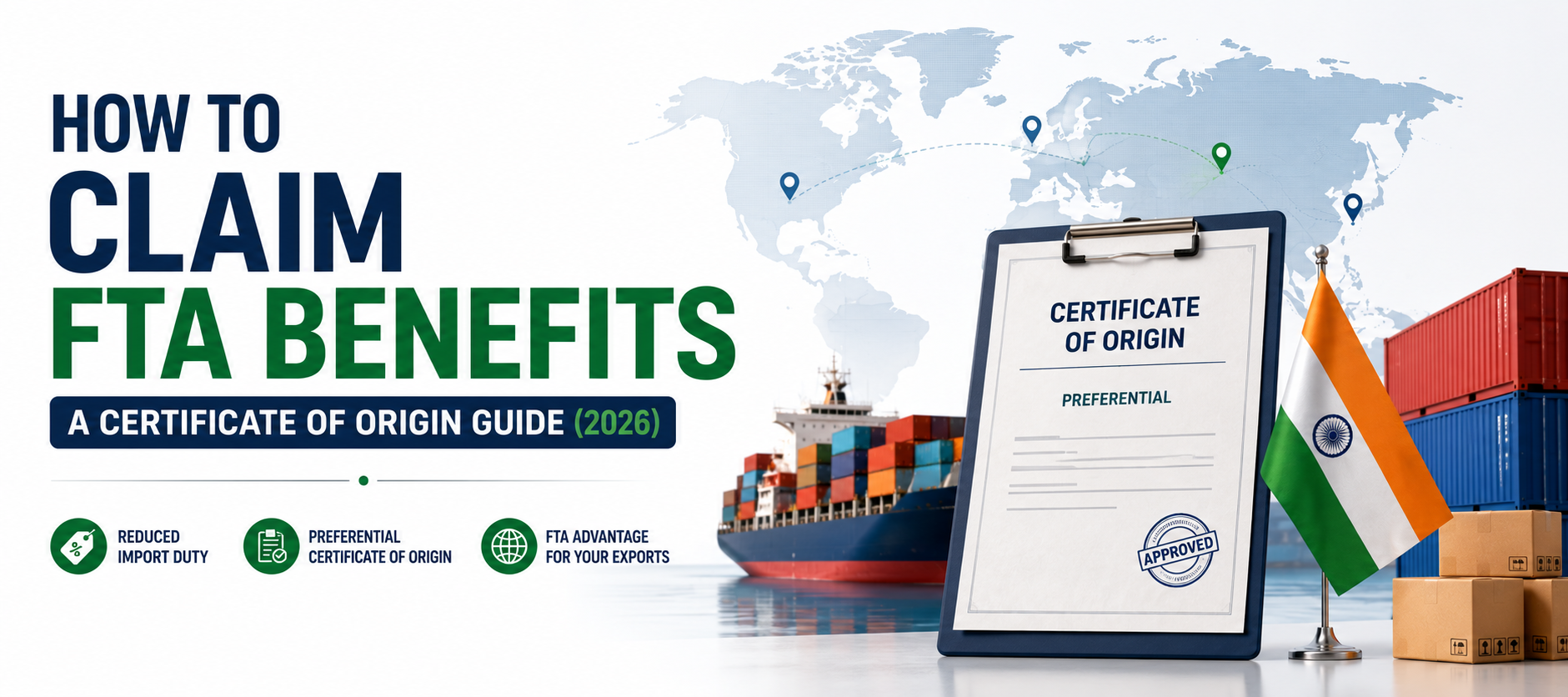
India has signed major trade deals — but most exporters never use the benefits. The missing piece is one document: the preferential Certificate of Origin. Learn what it is, why it matters, and exactly how to get one in 2026.
How to Claim FTA Benefits: A Certificate of Origin Guide (2026)
India has signed a wave of trade deals — the EU FTA, UK CETA, Oman CEPA, and more. But here is a hard truth: signing an FTA does not automatically make your exports cheaper. Studies suggest Indian exporters use only about a quarter of the FTA benefits available to them — leaving real money on the table.The missing piece is almost always one document: the preferential Certificate of Origin (CoO). This guide explains what it is, why it unlocks zero or reduced duty for your buyer, and exactly how to get one in 2026.
Why FTA Benefits Do Not Apply Automatically
When your buyer's customs clears your shipment, they charge the normal (MFN) duty — unless you prove the goods qualify for preferential treatment under an FTA. That proof is the preferential Certificate of Origin. No valid CoO, no reduced duty. It is that simple.Get it right and your buyer pays little or no import duty — which means you can quote lower and win the order, or hold price and earn more. Skip it, and the FTA is just a headline that never reaches your invoice.
Preferential vs Non-Preferential CoO
Preferential CoO
Issued under an FTA, CEPA, or CECA. This is the one that gives your buyer reduced or zero customs duty. Use this to claim FTA benefits.Non-Preferential CoO
Just certifies the goods are made in India, with no tariff concession. Used for general trade requirements.For claiming FTA benefits, you always want the preferential CoO for the specific agreement covering your buyer's country.
The Big 2026 Change: Everything is Digital Now
India has moved Certificate of Origin issuance fully online. Preferential CoOs are now applied for and issued electronically through the Trade Connect ePlatform (trade.gov.in) — India's unified digital eCoO system. Manually issued CoOs are no longer valid, so do not accept or rely on paper ones.You can obtain an eCoO through one of two routes:
- Self-Declaration — you self-certify origin using a Digital Signature Certificate (DSC) or Aadhaar authentication, generally without a fee
- Authorised Agency — a DGFT-authorised agency verifies and issues the certificate (used where the agreement requires it)
Before You Start: What You Need
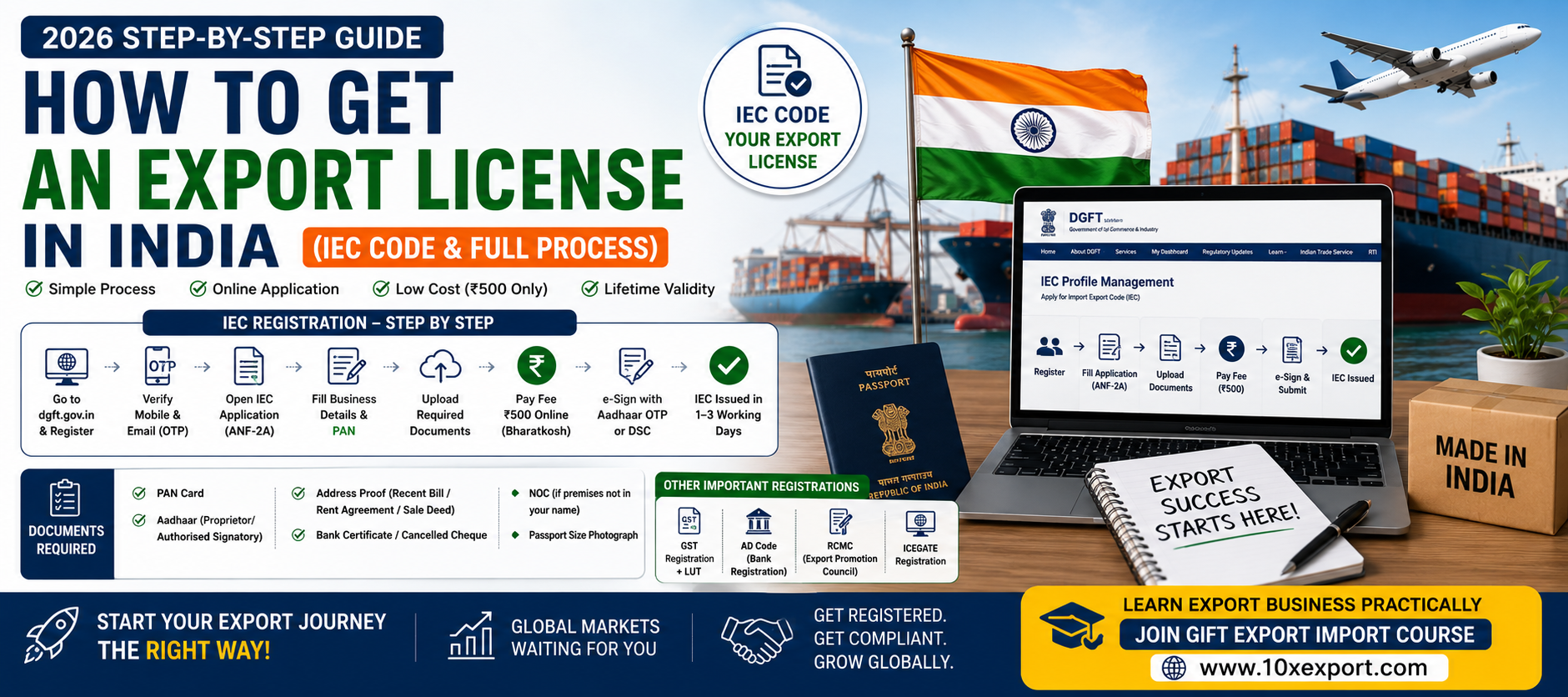
- A valid IEC with updated details in the DGFT system — see our Export License (IEC) Guide
- A Digital Signature Certificate (DSC) for self-declared eCoOs
- Your product's HS code and shipment details
- Clarity on the Rules of Origin for your product under the relevant FTA
Step by Step: Getting a Preferential eCoO
Step 1 — Log in to the Trade Connect ePlatform
Go to trade.gov.in and open the Certificate of Origin service.Step 2 — Select the Relevant Agreement
Choose the FTA covering your buyer's country — for example, India–UK CETA, India–Oman CEPA, or India–EFTA TEPA.Step 3 — Enter Product and Shipment Details
Fill in the HS code, product description, quantity, and value.Step 4 — Select Your IEC Branch Address
The system auto-maps your jurisdictional DGFT authority based on this selection.Step 5 — Declare Origin
Confirm your goods meet the Rules of Origin for the selected agreement.Step 6 — Submit
For self-declaration, the status shows "Auto Approved Pending Issuance." For agency-issued certificates, it goes for verification.Step 7 — Generate the eCoO
Sign with your linked DSC. The system issues an electronic certificate with a QR code and digital signature.Step 8 — Send to Your Buyer
Download the eCoO and send it to your buyer, who presents it to their customs to claim the preferential duty.Buyers or authorities can verify any certificate on Trade Connect via Certificate of Origin → Verify Certificate using the CoO number.
Rules of Origin: The Part That Trips People Up
A CoO is only valid if your goods actually originate in India under the agreement's rules. Broadly, goods qualify if they are either:- Wholly obtained in India — for example, agricultural produce grown here
- Sufficiently transformed in India — meeting the agreement's value-addition or processing criteria when inputs are imported
Which FTAs Can You Claim Right Now?
As of mid-2026, these are live and claimable with a preferential eCoO:- India–UK CETA — in force 15 July 2026
- India–Oman CEPA — in force 1 June 2026
- India–EFTA TEPA — in force since October 2025
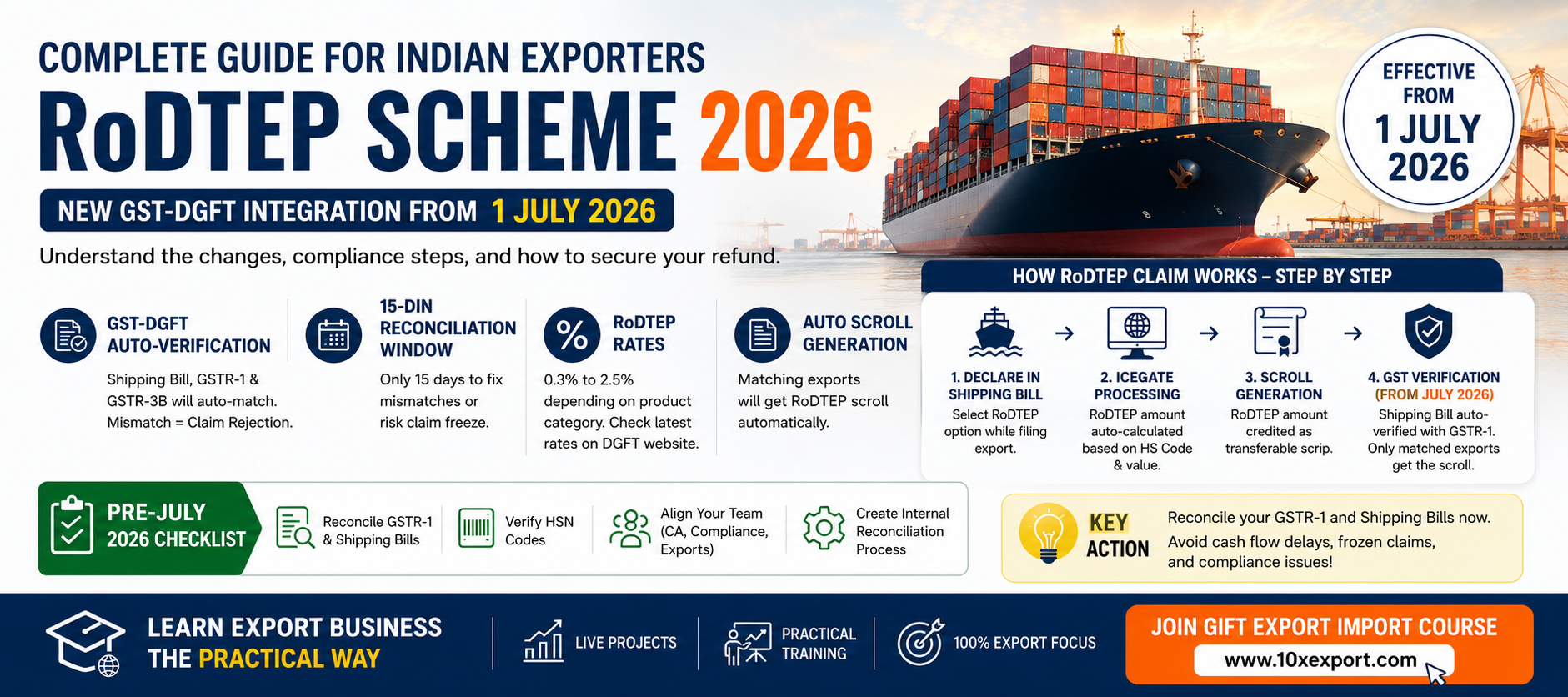
Once you are claiming FTA benefits, do not forget other incentives that stack on top — like RoDTEP. See our RoDTEP Scheme 2026 guide.
Common Mistakes to Avoid
- Skipping the CoO entirely — The single biggest reason exporters miss FTA savings
- Using the wrong agreement or format — Each FTA has its own preferential CoO. Pick the one for your buyer's country
- Outdated IEC details — If your IEC profile is not updated, the eCoO application fails
- Misjudging Rules of Origin — Claiming origin you cannot substantiate risks revocation and penalties
- Relying on manual or paper CoOs — These are no longer valid. Use the Trade Connect eCoO system only
Call To Action
Knowing the rules is one thing — using them shipment after shipment is another. In the GIFT Export Import Program, we walk you through registrations, Rules of Origin, Certificates of Origin, and claiming incentives — practically, on real exports — so the FTA advantage actually reaches your bottom line.👉 Join GIFT Export Import Course in Ahmedabad
India's most practical export training — for students, beginners, and entrepreneurs.
🚀 Start exporting the smart way in 2026 with GIFT Export Import Training.
Tags
Frequently Asked Questions
What is a preferential Certificate of Origin?
A preferential Certificate of Origin is an official document certifying that your goods qualify as originating in India under a specific FTA. It allows your buyer to claim reduced or zero import duty at their customs — without it, the normal MFN duty applies.
How do I get a Certificate of Origin in India in 2026?
Apply online through the Trade Connect ePlatform (trade.gov.in), select the relevant FTA for your buyer's country, declare origin, and generate an eCoO signed with your DSC. Manual or paper CoOs are no longer valid in India.
Is there a fee for getting a Certificate of Origin in India?
Self-declared eCoOs are generally issued without a fee. Agency-issued certificates may involve a charge depending on the specific agreement and the issuing agency.
Which FTAs can Indian exporters claim benefits under in 2026?
As of mid-2026, live FTAs include the India–UK CETA (in force 15 July 2026), India–Oman CEPA (in force 1 June 2026), and India–EFTA TEPA (in force since October 2025). The India–EU FTA is concluded but pending ratification — check the latest status before shipping.