General
How to Export from India Using E-Commerce Platforms (Amazon, Etsy, Shopify)
Selling to the world from India is now possible from home. E-commerce export is one of India's fastest-growing export channels in 2026. This guide walks you through how to get started, which platform to choose, and what documents you need.
Admin
May 16, 2026
How to Export from India Using E-Commerce Platforms (Amazon, Etsy, Shopify)
Selling to the world from India is now possible from home. E-commerce export is one of India's fastest-growing export channels in 2026. This guide walks you through step by step — how to get started, which platform to choose, and what documents you need.What is E-Commerce Export?
E-commerce export means selling a product made in India directly to a foreign buyer through an online platform.Earlier, export was only for large manufacturers and trading companies — big orders, big buyers, big logistics.
Today, a single artisan sitting in Rajasthan can sell handmade jewellery to buyers in the USA on Etsy. A small pharma accessories brand can ship to Europe through Shopify.
Why did this shift happen? Because:
- Digital payment platforms are now available (Payoneer, PayPal, Wise)
- International courier services (DHL, FedEx, Aramex) handle small parcels
- The government has created a simplified customs process for e-commerce exports
- Platforms like Amazon, Etsy, and Shopify have made their seller tools internationally ready
Why E-Commerce Export in 2026?
India's direct-to-consumer (D2C) e-commerce exports have grown significantly in 2025–26. The government's target is $350 billion in merchandise exports by 2027 — and e-commerce is one of the key pillars of this goal.Indian products with the highest international demand:
- Handicrafts and home decor
- Handmade jewellery
- Textiles and apparel
- Organic and natural products (spices, superfoods, herbal items)
- Ayurvedic and wellness products
- Art prints and custom products
- Leather goods
Which Platform Should You Choose?
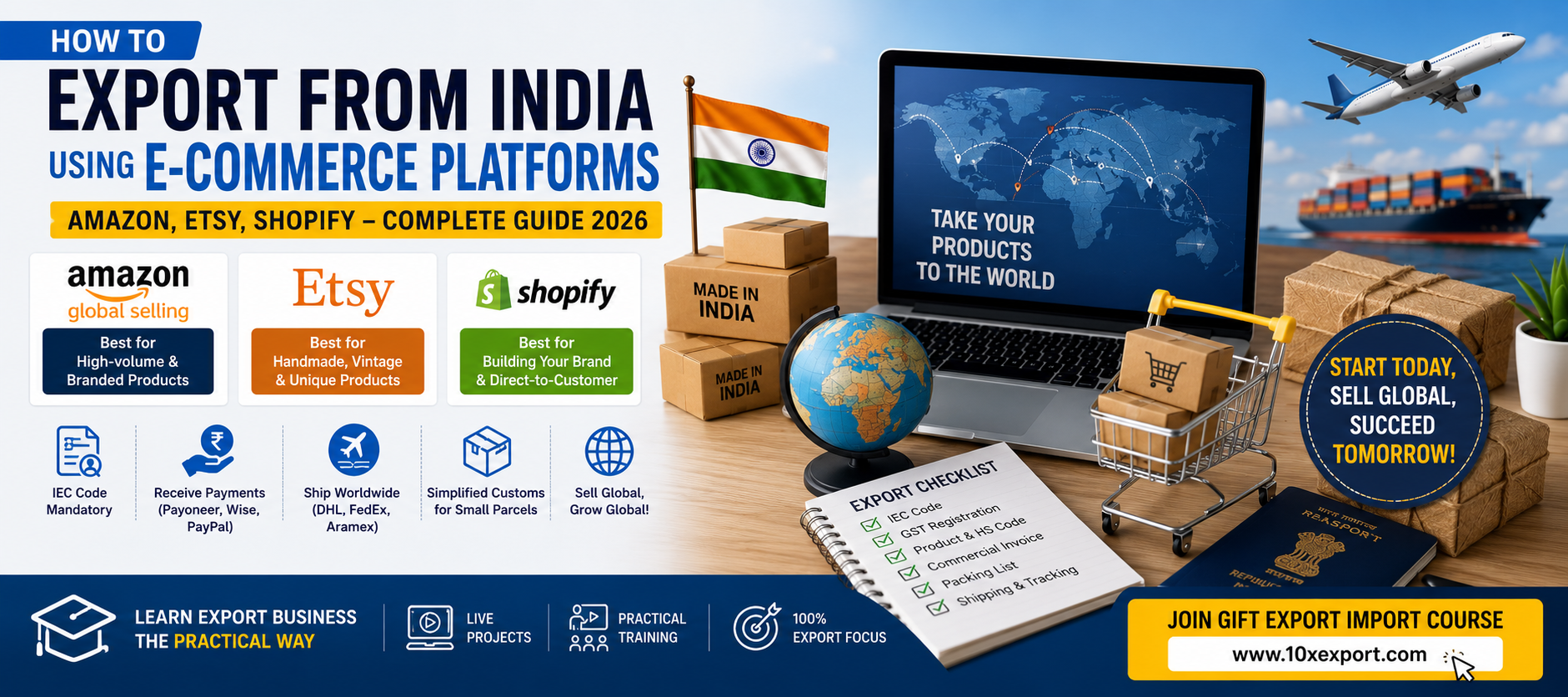
Amazon Global Selling
Best for: High-volume products, branded goods, established categoriesAmazon Global Selling lets you list your India inventory on Amazon US, UK, Germany, Japan, Canada, and 20+ other countries.
How it works:
- You can use the FBA (Fulfilled by Amazon) model — send stock to Amazon's warehouse and they handle delivery to customers
- Or FBM (Fulfilled by Merchant) — you ship each order directly from India
Advantages:
- Access to Amazon's existing customer base — no need to find buyers
- Brand Registry protects your intellectual property
- FBA means Amazon handles customer returns and service
Challenges:
- High competition — pricing pressure is real
- Amazon fees (referral fee + FBA fee) affect margins
- Category approval is required for some products
---
Etsy
Best for: Handmade, vintage, custom, and unique craft productsEtsy is the world's largest handmade marketplace. If you sell artisan products, handcrafted jewellery, home decor, custom gifts, or textile art — Etsy is ideal for you.
Indian sellers have been very successful on Etsy, especially with:
- Block print fabric and clothing
- Silver and beaded jewellery
- Brass and copper home decor
- Hand-painted art and prints
- Organic spices and teas
Advantages:
- Handmade product buyers are already willing to pay a premium price
- Global audience with high purchase intent
- Low setup cost
Challenges:
- Payment settlement in India was complex earlier — but Payoneer integration has resolved this
- Managing Etsy ads and competition requires attention
- Communicating shipping time for custom orders is important
---
Shopify (Direct-to-Consumer)
Best for: Building your own brand, getting repeat customers, not depending on AmazonOn Shopify, you build your own website. No marketplace, no middle platform — your brand, your terms.
Exporting with Shopify:
- The Shopify Markets feature supports multiple currencies and languages
- Shipping carriers (DHL, FedEx) integrate directly with Shopify
- Payment: Shopify Payments is not yet available in India — use Razorpay International or Payoneer instead
Advantages:
- Build and own your brand completely
- Customer data is yours — email marketing and retargeting are possible
- No Amazon or Etsy fees to pay
Challenges:
- You need to drive your own traffic (SEO, social media, ads)
- Slower start for beginners initially
- Customer acquisition cost is involved
What Do You Need for E-Commerce Export?
1. IEC – Import Export Code
IEC is mandatory for e-commerce exports as well. This is a 10-digit code issued by DGFT (Directorate General of Foreign Trade).Apply online at: dgft.gov.in
Documents required: PAN card, bank account, business address proof
Fee: ₹500
Processing time: 2–3 working days (mostly instant)
2. GST Registration
If your turnover exceeds ₹20 lakh, or you want to export as a registered business, GST registration is recommended. Export transactions are zero-rated under GST — meaning you get a refund on input taxes paid.3. Foreign Currency Account / Payment Gateway
Options to receive international payments:- Payoneer — most popular for Etsy and Amazon sellers
- Wise (formerly TransferWise) — low fees, good exchange rates
- PayPal Business — widely accepted but fees are higher
- Bank FIRC — Foreign Inward Remittance Certificate for direct bank transfers
4. Shipping Account
For small parcel international shipping:- DHL Express — fast, reliable, with tracking
- FedEx International — good for USA shipments
- Aramex — cost effective for Middle East
- India Post EMS (Speed Post) — budget option for non-urgent shipments
5. Packaging
Packaging must be strong for international shipping. Product damage leads to bad reviews and account issues. Use:- Double-wall corrugated boxes
- Bubble wrap or foam inserts
- Fragile labels where needed
- Branded packaging if you are running a D2C model
Customs Process for E-Commerce Export
India has a simplified process for e-commerce exports:Courier Exports (Small Parcels)
Low value shipments (generally under ₹25 lakhs per shipment) can be exported via courier mode. The process:Step 1 — Create Shipping Label
Generate the shipping label on the courier's software (DHL or FedEx portal).Step 2 — Prepare Commercial Invoice
Include buyer name, product description, value, and HS code.Step 3 — Attach Packing List
Include a detailed packing list with your shipment.Step 4 — Book Pickup
Book a pickup with the courier company — they handle customs filing for small packages.Step 5 — Share Tracking Number
Once picked up, share the tracking number with your buyer.Courier companies like DHL, FedEx, and Aramex handle customs clearance themselves for small packages. You do not need to do anything separately.
Handling Returns
International returns can be complex. Best practices:- Use Amazon FBA — they handle returns on your behalf
- On Etsy, clearly state no international returns (most handmade sellers do this)
- On Shopify, maintain a clearly written return policy
Pricing Strategy for E-Commerce Export
Many sellers make a mistake here. They add a small amount to their domestic price and list it — and then find no margin left.The correct pricing formula:
Export Price = Product Cost + Packaging + Shipping + Platform Fees + Payment Processing + Profit Margin
Example: Brass Decor Item
| Cost Component | Amount ||---|---|
| Product Cost | ₹400 |
| Packaging | ₹80 |
| DHL Shipping to USA | ₹600 |
| Etsy Fee (6.5%) | ~₹130 |
| Payment Processing (3%) | ~₹60 |
| Total Cost | ₹1,270 |
| Listed Price (30% margin) | ₹1,651 (~$20 USD) |
If you list at ₹15 (~$18), you will make a loss. Calculate first, then price.
Common Mistakes E-Commerce Exporters Make
Mistake 1: Starting Export Without IEC
Some courier companies allow small personal packages, but for regular commercial exports, IEC is mandatory. Issues arise later without it.Mistake 2: Wrong HS Code
Using the correct Harmonized System (HS) code is essential for customs. A wrong code leads to customs delays or seizure.Mistake 3: Poor Quality Product Photos
International buyers cannot physically see your product. Photos make the buying decision. Invest in professional photography.Mistake 4: Incorrect Shipping Time Estimate
Keep the shipping time listed on Etsy or Amazon accurate. Late delivery leads to bad reviews and account health issues.Mistake 5: Ignoring Currency Risk
You price in USD, receive payment, and if the rupee strengthens, your margin shrinks. Review your pricing regularly or consider hedging.Government Support for E-Commerce Exporters
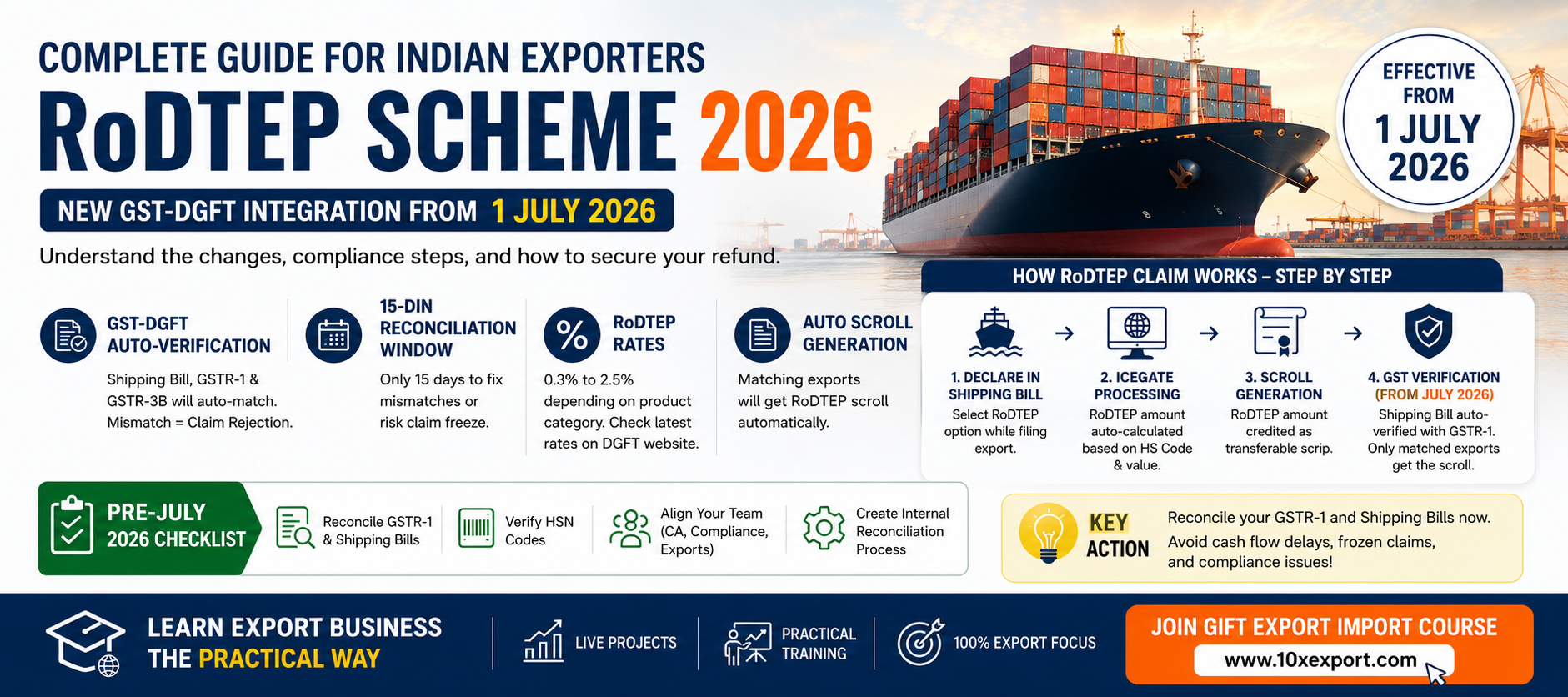
The Indian government is actively encouraging e-commerce exports. Key benefits:- RoDTEP Scheme — applicable on e-commerce exports too — you get a refund on taxes paid during production
- DGFT e-Commerce Export Hub — government is connecting digital platforms with exporters
- MSME Export Promotion — training and financial support through the MSME Ministry
- Niryat Mitra — DGFT's portal for export information, HS codes, and market access data
Frequently Asked Questions
Q: Can I do e-commerce export from home?
Yes. The IEC can be in your individual name (individuals can apply too), and you need a business bank account. A physical office is not mandatory for courier exports.Q: What is the minimum order quantity?
There is no minimum in e-commerce. You can sell and ship even a single item internationally.Q: How do I get a GST refund on exports?
Enter the export invoice in GSTR-1 and file an LUT (Letter of Undertaking) on the DGFT portal. After filing the LUT, you can do zero-rated exports without collecting GST, and claim an input tax credit refund.Q: How will Etsy payments reach my Indian bank account?
Etsy has integrated with Payoneer. Create a Payoneer account, link it to Etsy, and payments are transferred to your Indian bank account.Conclusion
E-commerce export is the most practical and affordable way for an ordinary Indian to access global markets today.Amazon Global Selling, Etsy, and Shopify — all three platforms have their own advantages. The right choice depends on your product, budget, and business model.
Getting started is simple: get your IEC, choose a platform, take good photos, set the right price, and ship your first order.
Ship your first international order — everything else falls into place after that.
Call To Action
Want to learn e-commerce export practically — with live buyer finding, documentation, and platform setup?👉 Join GIFT Export Import Course in Ahmedabad
India's most practical export training — with real business experience.
🚀 Join GIFT Export Import Training today.
Tags
#ecommerce export India#Amazon Global Selling India#Etsy export India#Shopify export#how to export from India#D2C export#IEC for export#export business beginners#GIFT export training