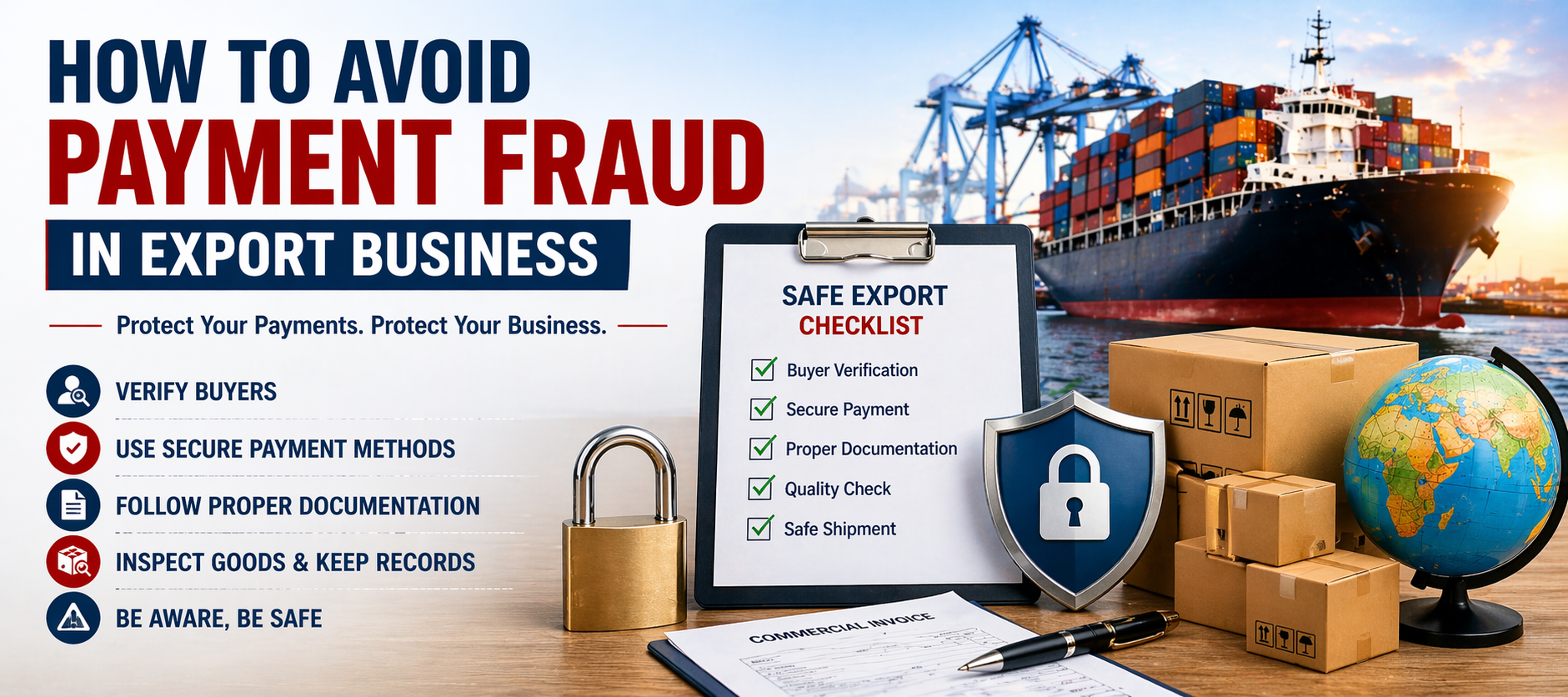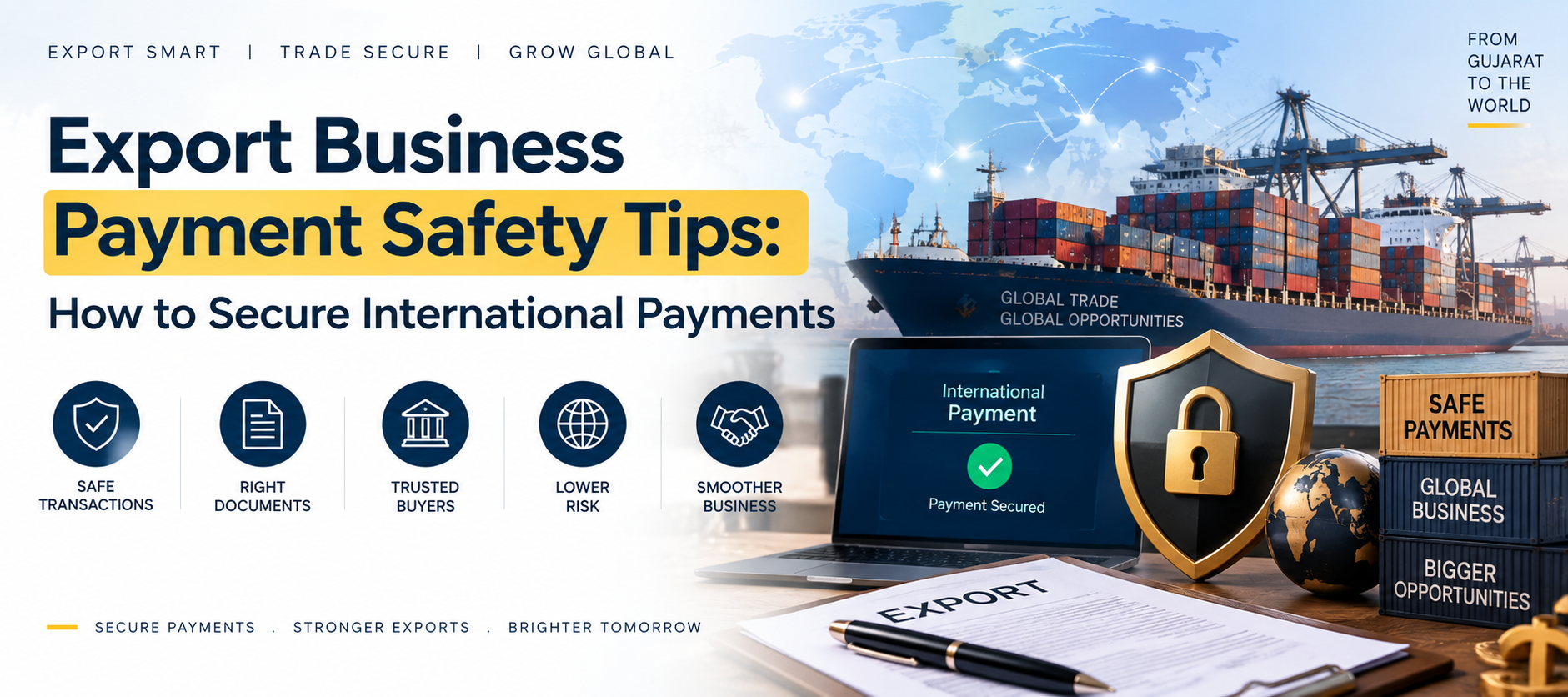
Export Business Payment Safety Tips: How to Secure International Payments
A profitable export order can become a financial loss if you ship without verifying the buyer or agree to risky payment terms. Learn 15 practical export payment safety tips — buyer verification, secure payment methods, fraud warning signs, and documentation best practices for Indian exporters.
Export Business Payment Safety Tips: How to Secure International Payments
Starting an export business from India gives manufacturers, traders, and entrepreneurs access to international buyers and global markets. But finding a buyer is only one part of successful exporting. One of the biggest challenges in international trade is making sure that you actually receive your payment safely and on time.A profitable export order can become a financial loss if an exporter ships goods without properly verifying the buyer, agrees to risky payment terms, or fails to check banking and export documents.
This is why export payment safety, buyer verification, secure payment terms, export documentation, and risk management should be considered before shipping any international order.
This guide explains practical export business payment safety tips, common payment methods, warning signs of payment fraud, and how practical export-import training such as the GIFT Export Import Training Program by 10X Exports can help exporters understand payment security.
---
Why Payment Safety Is Important in Export Business
International trade is different from domestic business. You may be dealing with a buyer located thousands of kilometres away, using a different banking system, currency, legal system, and business environment.Once goods leave India, recovering money from a non-paying buyer can become complicated.
Common payment-related risks in export business include:
- Fake international buyers and fake purchase orders
- Payment confirmation scams and fraudulent bank details
- Delayed payments and non-payment after shipment
- Unclear payment terms and fake Letters of Credit
- Email account compromise and unauthorized changes to bank account details
- Buyers requesting shipment before payment confirmation
- Currency and banking-related issues
Payment protection in export business should begin before accepting the order.
---1. Verify the International Buyer Before Accepting the Order
One of the most important export payment safety tips is to verify your buyer. Do not judge a buyer only by their website, email, LinkedIn profile, or the size of their purchase order.Before accepting a large export order, check:
- Company registration details and official website
- Business address and company email domain
- Import history, where available
- LinkedIn presence and trade references
- Buyer's bank details and contact person's identity
- Previous supplier references and country information
A buyer asking for a large shipment but refusing basic verification should be treated with extreme caution.
---2. Never Depend Only on a Purchase Order
A Purchase Order (PO) is important, but it should not be treated as proof that the buyer will definitely pay.An exporter should clearly agree on:
- Product specifications, quantity, and price
- Incoterms and delivery schedule
- Packaging and inspection requirements
- Payment terms and currency
- Bank charges and documents required
- Dispute resolution terms
---
3. Choose the Right Export Payment Method
There is no single payment method suitable for every international buyer and transaction. Common international payment methods include:Cash in Advance
The buyer pays before the goods are shipped. Trade.gov identifies cash-in-advance as the most secure payment method for exporters, although it may be less attractive to buyers. Common methods include bank wire transfer, credit card for certain transactions, and escrow arrangements in suitable cases.Partial Advance Payment
For some B2B export transactions, both parties may negotiate a partial advance — for example, 30% advance + 70% against shipping documents. The exact structure should be negotiated according to the transaction, product, buyer, and risk.Letter of Credit (LC)
Under an LC, the buyer's bank undertakes to make payment to the exporter when compliant documents are presented. See the detailed section below.Documentary Collection (D/C)
Banks handle documents and payment instructions between the exporter and importer. Documents may be released against payment at sight or the buyer's commitment to pay at a specified future date.Open Account
The exporter ships goods before receiving payment — for example, payment after 30, 60, or 90 days. This increases the exporter's credit risk significantly.---
4. Understand Letter of Credit (LC)
A Letter of Credit is an important payment instrument in international trade. Under an LC, the buyer's bank undertakes to make payment to the exporter when documents that comply with the LC's terms and conditions are presented.An exporter should carefully check:
- Issuing bank and amount
- Expiry date and latest shipment date
- Required documents and port details
- Product description and insurance requirements
- Inspection requirements and partial shipment conditions
- Transshipment conditions and discrepancy clauses
A small documentation discrepancy can create payment problems. Never accept an LC without carefully reviewing its terms — preferably with your bank or an experienced trade-finance professional.
---5. Be Careful With Open Account Payment Terms
Under open account payment, the exporter ships the goods before receiving payment. This can be attractive to established buyers, but it increases the exporter's credit risk considerably.Before offering open account terms, consider:
- How long you have known the buyer
- Buyer creditworthiness and payment history
- Previous transaction history and country risk
- Order value and trade credit insurance, where appropriate
Do not automatically offer open account terms simply because a buyer requests them.
---6. Confirm Payment Through Your Bank
One common mistake in export business is relying on a buyer's payment screenshot. A buyer may send: "Payment has been made. Please release the shipment." They may attach a fake bank receipt or payment confirmation.Do not treat a screenshot, email, or WhatsApp message as final confirmation of payment. Confirm the actual receipt of funds through your bank or authorized banking channel before taking action — especially for high-value export orders.
---7. Protect Your Bank Details
Bank details are extremely important in international trade. If your account information changes, communicate the change through a secure and independently verified channel.If someone sends an email saying "Our bank account has changed — please make the payment to this new account," do not immediately accept the new details. Instead:
- Contact the buyer using the previously verified phone number
- Confirm the change directly and verify the beneficiary details
- Inform your bank if necessary and keep written confirmation
Email accounts can be compromised, and fraudulent payment instructions can appear completely genuine.
---8. Watch for Common Export Payment Fraud Red Flags
Be cautious if a new buyer:- Places an unusually large first order
- Offers to pay far above your quotation
- Pressures you to ship immediately
- Refuses video calls or avoids providing company information
- Uses suspicious email addresses or provides inconsistent company details
- Sends questionable payment receipts
- Requests payment to a third-party account without a valid reason
- Requests shipment before agreed payment conditions are fulfilled
- Changes bank details at the last minute
- Gives complicated explanations for delayed payments
One red flag does not automatically prove fraud — but multiple inconsistencies should trigger additional verification before proceeding.
---9. Keep Proper Export Documentation
Payment security is closely connected with export documentation. Important documents may include:- Proforma Invoice and Purchase Order
- Commercial Invoice and Packing List
- Shipping Bill and Bill of Lading
- Certificate of Origin
- Inspection Certificate, where applicable
- Insurance documents, where required
- Letter of Credit documents, where applicable
---
10. Real-World Example: How a Payment Scam Can Happen
Consider a realistic export scenario.An Indian manufacturer receives an inquiry from a foreign company for USD 25,000 worth of furniture. The buyer sends a company profile, purchase order, passport/ID, shipping instructions, and a bank transfer screenshot.
The buyer then says: "We have already transferred the payment. Please ship the goods today because our customer is waiting."
The exporter checks the screenshot but does not verify the money in the bank account. Instead of waiting for actual payment confirmation, the exporter ships the goods. Later, the bank confirms that no payment was received. The buyer stops responding.
What went wrong?
The exporter did not independently verify the buyer, relied on a payment screenshot, shipped before confirming receipt of funds, and did not properly manage the transaction's payment risk.What should have happened?
Verify buyer → Agree payment terms → Confirm payment through bank → Complete documentation → Ship according to agreed terms.Never confuse proof of payment with actual receipt of payment.
---11. Use Incoterms Correctly
Incoterms define important responsibilities between buyers and sellers — including aspects of delivery, costs, and risk. Common Incoterms include EXW, FCA, FOB, CIF, CFR, DAP, and DDP.However, Incoterms do not themselves determine the payment method. For example, an order can be:
- FOB + Advance Payment
- FOB + Letter of Credit
- CIF + Documentary Collection
Keep delivery terms and payment terms clearly defined separately in your quotation and contract.
---12. Maintain a Written Payment Policy
If you regularly export products, create a standard export payment policy:| Buyer Type | Recommended Approach |
|---|---|
| New Buyer | Advance payment or LC, depending on risk and transaction |
| Repeat Buyer | Negotiated payment terms based on transaction history |
| High-Value Order | Additional buyer verification and appropriate payment protection |
| High-Risk Market | Enhanced due diligence and more secure payment arrangements |
Your policy should also specify who has authority to approve exceptions.
---
13. Train Your Team on Export Payment Security
Payment fraud does not always target the company owner. A sales employee, accountant, export executive, or logistics employee may receive a fraudulent email or payment instruction.Your team should know:
- How to verify buyers and payment terms
- How to identify suspicious emails
- How to verify bank details
- When shipment can be released
- Which documents are required
- Who must approve payment-related changes
A simple internal payment verification process can prevent expensive mistakes.
---Export Payment Safety Checklist
Use this checklist before shipping any international order:Buyer
- Have I verified the buyer's company?
- Have I verified the contact person?
- Have I checked the buyer's business information?
Payment
- Are payment terms clearly written?
- Is the payment method appropriate for the buyer and transaction?
- Have I verified the bank/payment instructions?
- Have I actually received the payment?
Documentation
- Is the PO correct?
- Is the Proforma Invoice correct?
- Are product details consistent across all documents?
- Are shipping documents accurate?
Shipment
- Have payment conditions been fulfilled?
- Are Incoterms clearly mentioned?
- Are shipment instructions verified?
- Has the final shipment been approved internally?
How GIFT Export Import Training Helps With Payment Safety
Learning export business only through theory can make payment terms confusing — especially for beginners.The GIFT Export Import Training Program by 10X Exports is a 45-day, 100% practical offline training program covering 250+ topics across 18 modules, including:
- International buyer verification and communication
- Payment terms and payment safeguarding
- Cash-in-advance, Letter of Credit, and Documentary Collection
- Export documentation and risk management
- Shipping and logistics
- Customs clearance
- Real-time export case studies and practical deal execution
👉 Learn More — GIFT Export Import Training
---
Frequently Asked Questions
What is the safest payment method in export business?
Cash-in-advance provides strong protection to exporters because payment is received before shipment. However, it may be less attractive to buyers. The right method depends on the buyer, transaction value, and risk involved.Is a Letter of Credit safe for exporters?
An LC can provide significant payment protection because the issuing bank undertakes payment subject to compliance with the LC terms and required documents. However, document accuracy is critical — even a small discrepancy can create payment issues.How can I verify an international buyer?
Check the buyer's company information, website, business registration, trade references, contact details, and import history where available. Conduct a direct video call and independently verify the buyer's details before accepting a large order.Should I ship goods after receiving a payment screenshot?
No. A payment screenshot is not the same as confirmed receipt of funds. Always confirm actual payment through your bank or authorized banking channel before releasing any shipment.What is open account payment in export?
Under open account terms, the exporter ships goods before receiving payment — such as payment after 30, 60, or 90 days. This carries significant credit risk and should only be offered to well-known, verified buyers with a strong payment history.What are common export payment frauds?
Common risks include fake payment confirmations, fraudulent bank details, fake buyers, compromised email accounts, and requests to ship before payment is actually received. Multiple red flags appearing together should trigger additional verification immediately.Why is buyer verification important before accepting an export order?
Buyer verification helps exporters understand who they are dealing with and identify inconsistencies before committing goods, production capacity, or money to a transaction. It is the first line of defence against payment fraud.Where can I learn practical export payment safety?
The GIFT Export Import Training Program by 10X Exports provides 45-day, offline, practical export-import training in Ahmedabad, covering payment safeguarding, buyer finding, export documentation, logistics, customs clearance, and real export-import case studies.---
Conclusion
Payment safety is one of the most important parts of a successful export business. Finding an international buyer is not enough — an exporter must also verify the buyer, negotiate clear payment terms, choose an appropriate payment method, protect banking information, maintain accurate export documentation, and confirm actual receipt of funds before proceeding.Remember these five rules: Verify the buyer. Choose secure payment terms. Never trust screenshots blindly. Keep documentation accurate. Confirm payment before shipping when your agreed terms require it.
Call To Action
For entrepreneurs and beginners who want to understand these processes practically — GIFT Export Import Training by 10X Exports provides structured learning covering payment safeguarding, buyer finding, export documentation, logistics, customs clearance, and real export-import case studies.👉 Join GIFT Export Import Course in Ahmedabad
India's most practical export training — for students, beginners, and entrepreneurs.
🚀 Learn export. Understand the risks. Protect your payments. Build your international business systematically.
Tags
Frequently Asked Questions
What is the safest payment method in export business?
Cash-in-advance is the safest payment method for exporters because payment is received before shipment — eliminating the risk of non-payment. However, it may be less attractive to buyers. The right method depends on the buyer relationship, transaction value, and risk involved.
Should I ship export goods after receiving a payment screenshot?
No. A payment screenshot, email, or WhatsApp message is not the same as confirmed receipt of funds. Always verify actual payment through your bank or authorized banking channel before releasing any shipment — especially for high-value export orders.
How can I verify an international buyer before accepting an export order?
Check the buyer's company registration, official website, business address, import history, LinkedIn presence, and trade references. Conduct a direct video call and ask specific questions about their business and previous imports. A buyer who refuses basic verification should be treated with extreme caution.
Is a Letter of Credit safe for Indian exporters?
An LC can provide significant payment protection because the issuing bank undertakes payment subject to compliance with the LC's terms. However, document accuracy is critical — even a minor discrepancy can delay or complicate payment. Always review LC terms carefully with your bank before accepting.
What are the most common export payment fraud red flags?
Common red flags include unusually large first orders, pressure to ship immediately, refusal to do video calls, suspicious email addresses, fake payment screenshots, requests to pay a third-party account, and last-minute bank detail changes. Multiple inconsistencies appearing together should trigger immediate additional verification before proceeding.