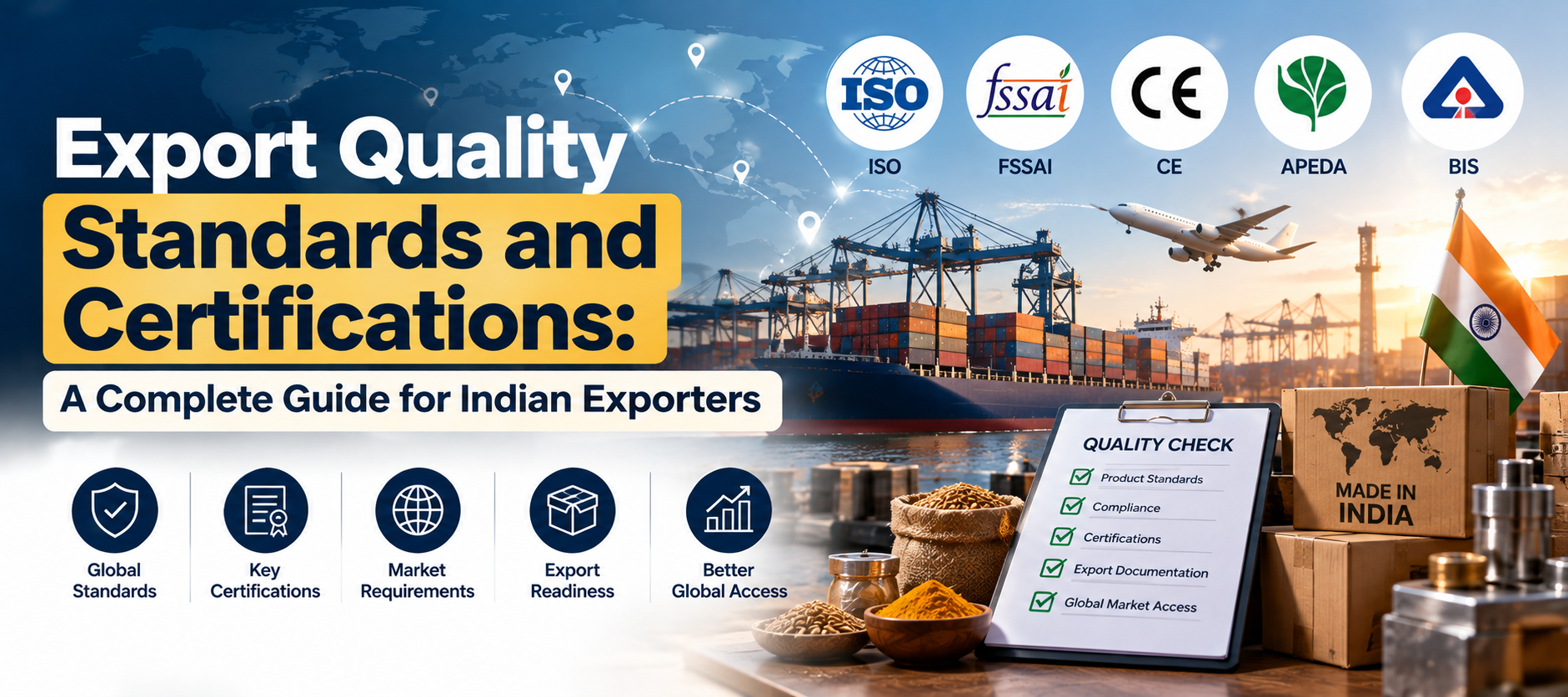
Export Quality Standards and Certifications: A Complete Guide for Indian Exporters
Learn which export quality standards and certifications your product needs, from ISO, BIS and CE marking to HACCP and FSSAI, plus a quality control checklist and a 7-step method to find the right certification for your target market.
Export Quality Standards and Certifications: A Complete Guide for Indian Exporters
Exporting to international markets is not only about finding buyers and offering competitive prices. Product quality, export quality standards, certifications, testing, packaging and regulatory compliance matter just as much.Different countries and products have different import requirements. Understanding them before shipping helps exporters avoid shipment delays, rejections, extra costs and compliance issues.
---
What Are Export Quality Standards?
Export quality standards are the quality, safety, technical, labelling, packaging and regulatory requirements a product must meet to enter a particular international market.These requirements depend on:
- Product category
- Destination country
- HS Code
- End use of the product
- Buyer requirements
- Import regulations
- Industry-specific standards
---
Why Are Quality Standards Important in Export Business?
Meeting international quality standards helps exporters:- Build buyer confidence
- Reduce the risk of product rejection
- Meet country-specific import requirements
- Enter regulated international markets
- Maintain consistent product quality
- Improve business credibility
- Build long-term relationships with international buyers
For many B2B buyers, certifications and quality documentation are a standard part of their supplier evaluation process.
---Common Certifications and Standards for Exporters
The certification you need depends on your product and destination market. Here are the most commonly encountered ones.1. ISO Certification
ISO standards help businesses build consistent processes and quality management systems. ISO 9001 is widely used for Quality Management Systems and shows that a company follows structured quality processes.2. BIS Certification
The Bureau of Indian Standards (BIS) sets standards for a wide range of products in India. Certain products may require mandatory BIS certification or compliance under applicable regulations.3. CE Marking
For certain products entering the European Economic Area, CE marking may be required to show conformity with applicable EU legislation. Whether it applies depends on the product category and the specific EU regulations for it.4. HACCP
HACCP (Hazard Analysis and Critical Control Points) is a food safety management approach used to identify and control food safety hazards.5. FSSAI
For businesses dealing in food products in India, FSSAI compliance and licensing may be relevant depending on the business activity and product.6. Product-Specific Certifications
Some industries need additional certifications, test reports or compliance documents, such as:- Textile certifications
- Organic certifications
- Food safety certifications
- Chemical compliance
- Electrical safety certifications
- Environmental certifications
- Wood and plant-product documentation
Quick Reference Table
| Certification / Standard | What It Covers | Commonly Relevant For ||---|---|---|
| ISO 9001 | Quality management systems | Most manufacturing and B2B supply |
| BIS | Indian product standards | Products notified under Indian regulations |
| CE Marking | Conformity with EU legislation | Certain products sold in the European Economic Area |
| HACCP | Food safety hazard control | Food processing and food exports |
| FSSAI | Indian food safety compliance and licensing | Food businesses in India |
| Product-specific | Testing, organic, chemical, electrical, plant-product compliance | Depends on product and market |
Important: Don't assume one certification is accepted everywhere. Always verify the exact requirements for your product, HS Code and target export country.
---Export Quality Control: What Should Exporters Check?
Before shipping an export order, follow a proper quality control checklist.Product Quality
Check dimensions, materials, specifications, functionality, finish and workmanship.Packaging Quality
Packaging should suit international transport and protect the product from damage, moisture, handling and storage conditions.Labelling
Check whether the destination country or buyer requires specific labels, markings, product information, country of origin, warnings or other details.Testing & Inspection
Depending on the product, buyers or authorities may require laboratory testing, inspection certificates or conformity documents.Documentation
Make sure the commercial invoice, packing list, certificate of origin, inspection reports and other required certificates are prepared correctly.---
How to Find Out Which Certification You Need
Before investing in any certification, follow these seven steps.Step 1: Identify Your Product and HS Code
Your HS Code is the starting point for every regulatory check.Step 2: Select the Target Export Country
Requirements differ significantly from one market to another.Step 3: Check the Country's Import Regulations
Verify what the destination country requires for your product category.Step 4: Understand the Buyer's Quality Specifications
Many buyers have requirements beyond what the law requires.Step 5: Check Whether Testing or Certification Is Mandatory
Separate mandatory requirements from optional ones.Step 6: Arrange Certification or Testing
Work with the appropriate authorized body or laboratory.Step 7: Maintain Quality Records
Keep records for future shipments and buyer audits.This approach saves you from spending money on certifications your product or target market doesn't actually need.
Also make sure your basic export registrations are in place. Read our Export License Guide and AD Code & RCMC Guide. Your Export Promotion Council can also be a useful source of sector-specific compliance information.---
How GIFT Export Import Training Helps
Understanding export documentation, quality standards, certifications, compliance, packaging and trade procedures can be difficult when you are just starting out.The GIFT (Global International Foreign Trade) Export Import Training Program by 10X Exports focuses on practical learning rather than theory alone. It is a 45-day, 100% offline program in Ahmedabad covering 250+ topics across 18 modules, including:
- Export documentation
- Packaging and branding
- Logistics and customs clearance
- International buyer finding
- Payment terms
- Real export case studies
Explore GIFT Export Import Training
---
Conclusion
Export quality standards and certifications are a core part of international trade. Before exporting, identify the applicable product standards, testing requirements, certifications, labelling rules, packaging requirements and buyer specifications for your target market.With practical knowledge of documentation, compliance, buyer finding, logistics, customs clearance and quality requirements, you can approach international trade far more systematically.
Want to learn export-import practically? Explore the GIFT Program by 10X Exports
Tags
Frequently Asked Questions
What are export quality standards?
Export quality standards are the requirements for product quality, safety, testing, packaging, labelling and regulatory compliance that a product must meet to be sold in a specific international market. They vary by product, HS Code and destination country.
Is ISO certification mandatory for export?
No, ISO certification is not automatically mandatory for every exporter or product. Whether you need it depends on your product, industry, buyer and target market. Many B2B buyers do prefer ISO 9001-certified suppliers as part of their evaluation.
Which certification is required for export from India?
There is no single certification required for every product. Requirements depend on your product, HS Code, destination country and applicable regulations. Start with your HS Code and target market, then verify the specific requirements.
What is CE marking for export?
CE marking is used on certain products placed on the European Economic Area market to show conformity with applicable EU legislation. Whether your product needs it depends on its category and the EU regulations that apply to it.
How can I check certification requirements for my product?
Start with your HS Code, product specifications and target country. Then verify the destination's import regulations, the buyer's specifications, and whether testing or certification is mandatory. Practical programs like GIFT Export Import Training by 10X Exports cover how compliance fits into the full export process.