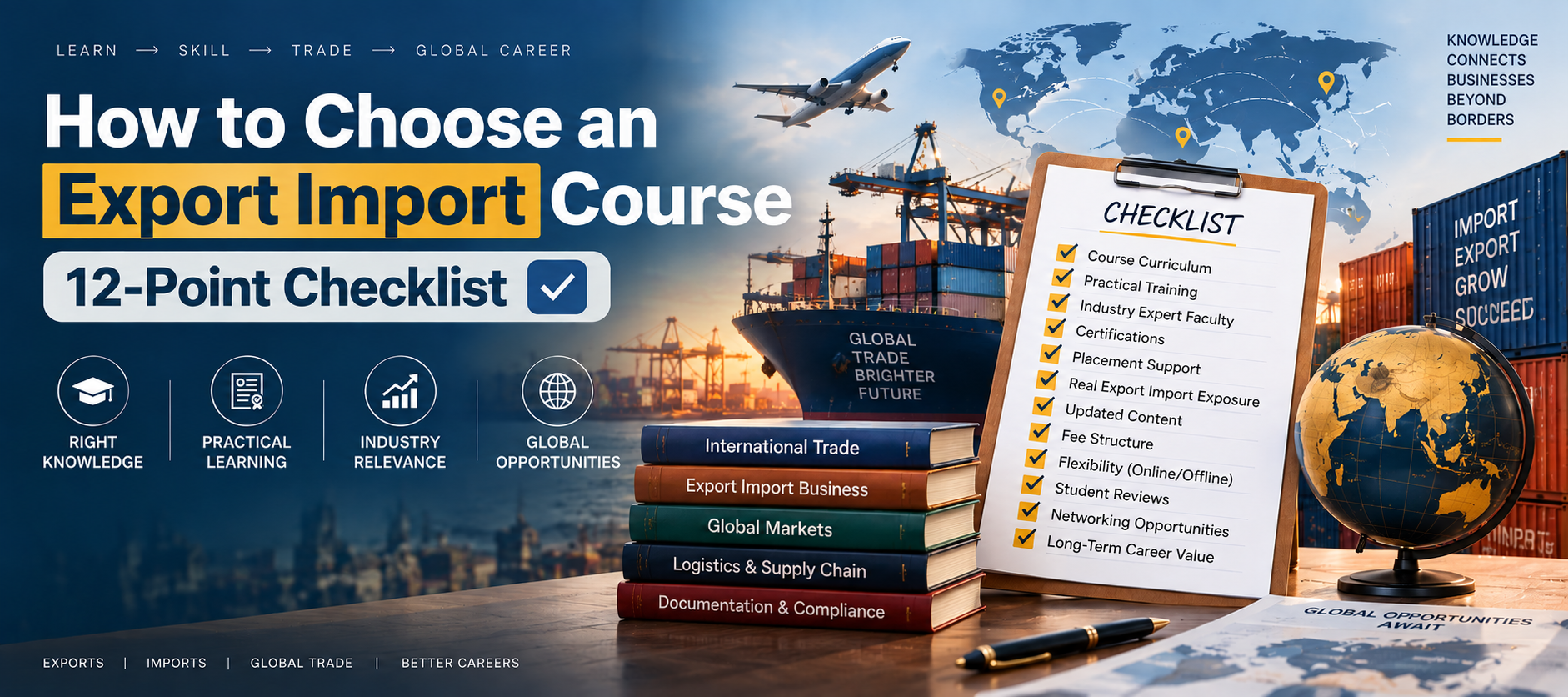
How to Choose an Export Import Course: 12-Point Checklist
Not every export import course teaches you how to execute a real export order. Use this 12-point checklist to compare courses on practical training, buyer finding, costing, documentation, payment terms, logistics and post-training support.
How to Choose an Export Import Course: 12-Point Checklist
If you plan to start an export business from India, build a career in international trade, or take your existing business global, choosing the right export import course can save you a lot of time, money and confusion.There are many export-import training programs, online courses, certification courses and foreign trade institutes available today. But not every course teaches you how to actually execute an export transaction.
A course may explain terms like IEC, HS Code, Incoterms, Letter of Credit, Shipping Bill and Bill of Lading. Running a real export business requires much more. You need to know how to:
- Select a profitable export product
- Identify target international markets
- Find international buyers
- Communicate with buyers
- Calculate export prices
- Handle payment terms
- Prepare export documentation
- Manage customs clearance
- Coordinate shipping and logistics
- Execute an actual export order
---
The 12-Point Checklist
1. Is the Course Practical or Theory-Based?
This should be your first question.Ask: "Will I actually perform export-import activities, or will I only attend lectures?"
A practical course should expose you to:- Buyer research
- Product research
- Export costing
- Documentation
- Buyer communication
- Logistics and customs procedures
- Payment terms
- Real trade cases
What to Look For
- Practical sessions
- Live activities
- Real case studies
- An actual export-import workflow
2. Does It Teach the Complete Export Process?
A good export-import course for beginners should not teach isolated topics. You need to understand the complete flow:Product Selection → Market Research → Buyer Finding → Quotation → Negotiation → Order → Payment → Production → Documentation → Customs → Shipping → Delivery
If a course covers only theory or one part of international trade, you may still struggle when handling a real buyer.
The GIFT curriculum covers export-import basics and process, product selection, target-country selection, international digital marketing, buyer and supplier finding, e-commerce exports, payment safeguarding, container booking, customs clearance, documentation, shipping and logistics.
3. Does It Teach International Buyer Finding?
The biggest challenge in export business is not understanding what exporting means. It is finding genuine international buyers.Your course should teach practical methods for:
- International buyer research
- B2B platforms and trade databases
- Digital marketing and email outreach
- LinkedIn prospecting
- Buyer communication
- Supplier finding
- Buyer verification
Ask before joining: "Will I actually learn how to find buyers, or will the course only list buyer-finding websites?" That difference matters.
4. Are Export Costing and Pricing Included?
A profitable export order starts with correct export costing. You should learn to calculate:Product Cost + Packaging + Inland Transportation + Documentation + Customs/Port Costs + Freight + Insurance + Other Applicable Costs + Profit Margin
You should also understand:
- EXW, FOB and CIF pricing
- Freight and CBM calculation
- Container costs
- Profit margins
- Buyer quotations
- Currency conversion
5. Does It Cover Export Documentation?
Export documentation is one of the most important parts of international trade. Your course should explain documents such as:- Commercial Invoice
- Proforma Invoice
- Packing List
- Shipping Bill
- Bill of Lading / Airway Bill
- Certificate of Origin
- Purchase Order
- Insurance documents
- Product-specific certificates
GIFT includes customs clearance and documentation, along with practical export-import processes.
6. Does It Cover IEC, GST and MSME?
Before starting an export business from India, you need the right business and regulatory setup. Look for training on:- IEC (Importer Exporter Code)
- GST
- MSME/Udyam registration
- Business setup
- Export-related registrations
- Government benefits, incentives and subsidies
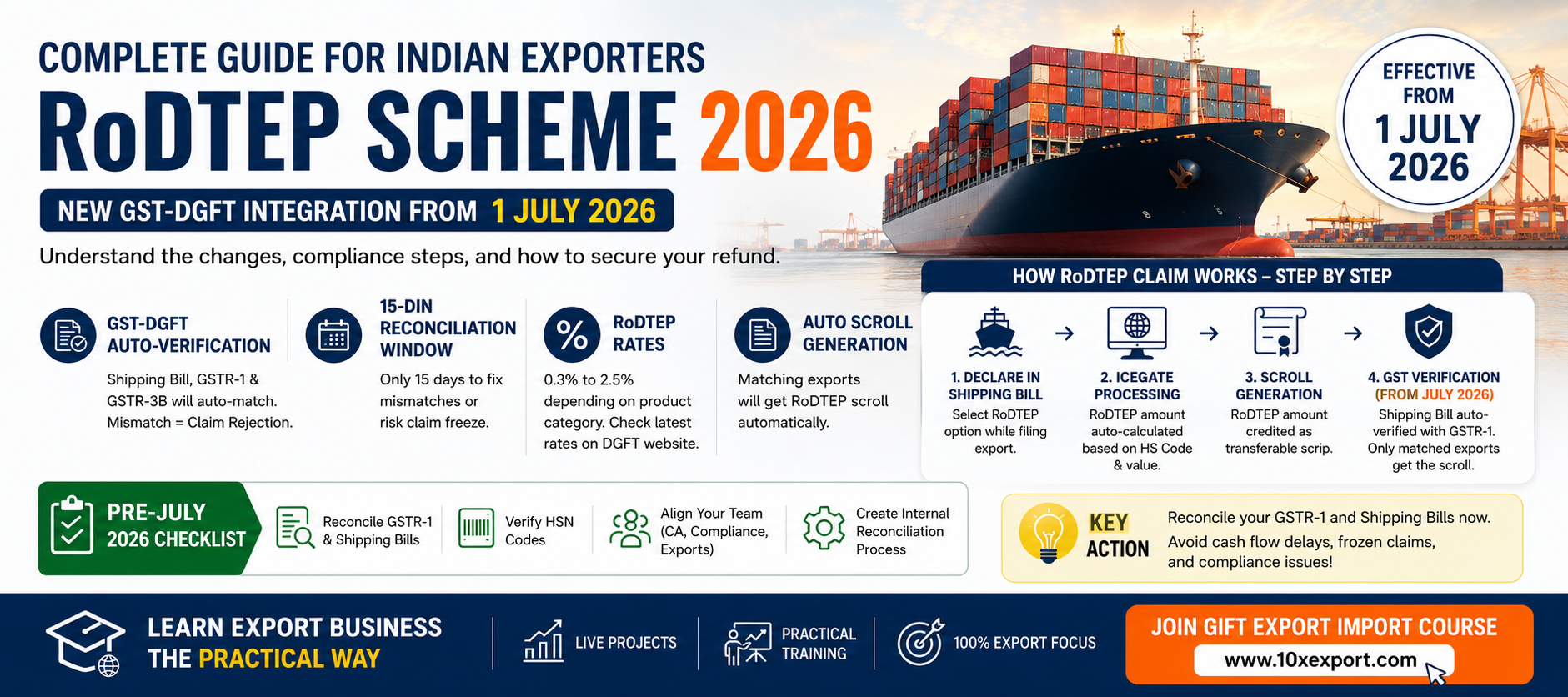
Related reading: Export License Guide, AD Code & RCMC Guide and RoDTEP Scheme 2026 Guide
7. Does It Teach Payment Terms and Risk Management?
Finding a buyer is not enough. You need to know how you will get paid. A good international trade course should cover:- Advance payment
- Letter of Credit (LC)
- Documentary Collection
- Open Account
- Payment safeguards
- Buyer verification
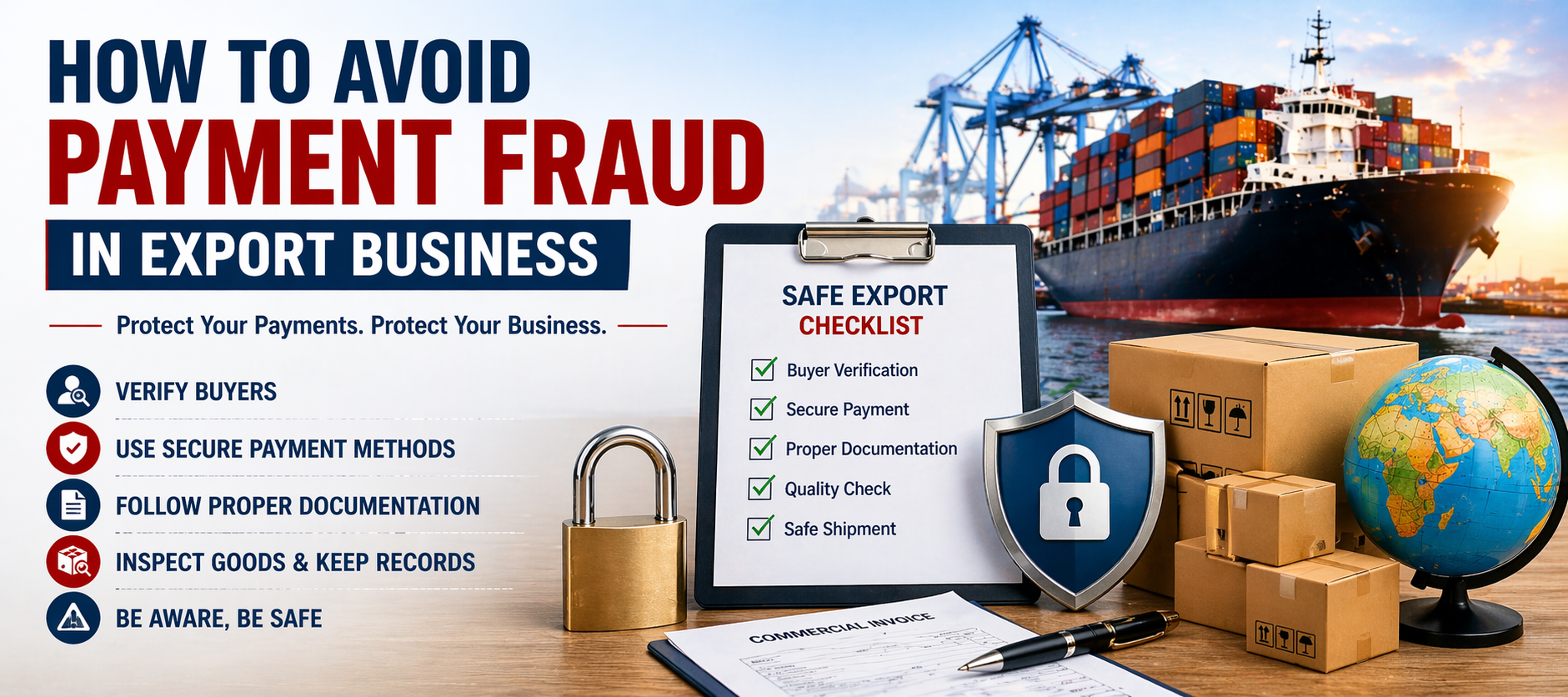
- Payment fraud
- Bank documentation
Example: The Payment Screenshot Trap
An Indian exporter receives a USD 30,000 order from a new buyer. The buyer sends a payment screenshot and asks for immediate shipment.Would you ship?
A practical export course should teach you to assess such situations and verify payment according to the agreed terms before acting. GIFT specifically lists "Understanding how to Safeguard Payments" among its course topics.
8. Does It Teach Shipping, Logistics and Customs?
Export business does not end when goods leave your factory. You need to understand:- Freight forwarders and shipping lines
- Container booking
- LCL vs FCL
- Port procedures and handling
- Customs clearance
- Shipping documents
- Freight charges
- Cargo movement and logistics coordination
9. Does the Course Include Real-World Case Studies?
International trade involves situations a textbook cannot fully explain. Look for courses with:- Real export-import case studies
- Buyer communication examples
- Pricing situations
- Documentation examples
- Payment scenarios
- Logistics and customs problems
- Shipment execution
Why it matters: Knowing the definition of an LC does not mean you can check an LC received from a buyer. Knowing what FOB means does not mean you can prepare a correct FOB quotation. Case studies connect theory with execution.
GIFT highlights real-time export-import case studies and analysis as part of its training approach.10. Are Industry Experts Involved?
One international shipment involves many professionals. A useful course exposes you to perspectives from:- Exporters and importers
- Customs House Agents
- Freight forwarders
- Banks
- Logistics professionals
- Industry experts
11. Is There Support After the Course?
Learning does not end on the last day of training. When you start executing real transactions, you will have questions like:- "Which document should I prepare?"
- "How should I calculate freight?"
- "How should I respond to this buyer?"
- "What should I check before shipment?"
Note: Always confirm the current terms and eligibility for specific benefits before enrolling.
12. Can You Start Your Own Export Business While Learning?
This is a key question for entrepreneurs. A good course should move you from:Learning → Planning → Executing
and not:
Learning → Certificate → Stop
GIFT promotes building your own business alongside the training and executing export-import processes from the first day. This lets you connect classroom learning with your own products, target markets and business goals.
---
12-Point Export Import Course Checklist (Quick Summary)
| No. | What to Check | Why It Matters ||---|---|---|
| 1 | Practical training | Learn by doing |
| 2 | Complete export process | Understand the entire workflow |
| 3 | International buyer finding | Generate real business |
| 4 | Export costing | Prepare profitable quotations |
| 5 | Export documentation | Avoid costly mistakes |
| 6 | IEC, GST & MSME | Set up your business correctly |
| 7 | Payment terms | Reduce payment risk |
| 8 | Shipping & logistics | Understand shipment execution |
| 9 | Real case studies | Connect theory with practice |
| 10 | Industry experts | Learn from trade professionals |
| 11 | Post-training support | Get help during execution |
| 12 | Business execution | Apply learning to your own business |
If a course shows strong coverage across these areas, you have a solid basis for comparing it with alternatives.
---
Real-World Example: Why the Right Training Matters
Consider Rahul, a hypothetical Indian manufacturer who wants to export wooden furniture. He knows how to manufacture the product but has never exported.Scenario 1: Theory-Only Course
Rahul learns what IEC, FOB, CIF, HS Code and Bill of Lading mean. After the course, he finds a buyer in Europe who asks:"Please send your FOB quotation for 500 chairs."
Rahul knows what FOB means, but he cannot calculate packaging cost, inland freight, port charges, documentation costs, freight-related costs or his profit margin. He also doesn't know how to verify the buyer or negotiate payment terms.Scenario 2: Practical Training
During practical training, Rahul works through the full sequence:Product Selection → Target Country → Buyer Finding → Buyer Communication → Export Costing → Quotation → Payment Terms → Documentation → Customs → Shipping
That is the difference between knowing export terminology and knowing how to execute an export transaction. GIFT's training model is built around live projects, real-time case studies, buyer communication and executing processes while learning.
---
GIFT Export Import Training: What Makes It Practical?
The GIFT (Global International Foreign Trade) Program by 10X Exports is a 45-day, 100% offline, practical export-import training program in Ahmedabad, covering 250+ topics across 18 modules.Major areas covered:
- Export-import fundamentals
- GST, IEC and MSME
- Government benefits and subsidies
- Profitable product selection
- Target-country selection
- International digital marketing
- 20+ buyer and supplier finding methods
- E-commerce exports
- Branding and packaging
- Payment safeguarding
- Container booking
- Customs clearance and export documentation
- Shipping and logistics
Learn more about the GIFT Program
---
How GIFT Training Helps Beginners
For complete beginners, the challenge is not finding information. There is plenty online. The challenge is knowing:- What to do first, and what comes next
- Who is responsible for each step
- Which document is needed
- How much it will cost
- How to find and communicate with buyers
- How to execute the shipment
---
Online vs Offline Export Import Course: Which Should You Choose?
Online Courses
Convenient. You can learn from anywhere at your own pace.Offline Courses
Offer more direct interaction, classroom discussion and physical exposure such as port and industry visits.The right choice depends on your learning style and goals. GIFT is 100% offline and practical, with its training centre in Ahmedabad, which suits learners looking for hands-on exposure and direct interaction with industry professionals.
---
Who Should Join an Export Import Course?
Students
Those interested in international trade, export-import jobs, foreign trade and global business can learn fundamentals and practical processes.Business Owners
Manufacturers and traders can learn to expand from the domestic market into international markets.Working Professionals
Professionals can build skills in export documentation, logistics, international sales and trade operations.Entrepreneurs
Anyone planning to start an export business from India can learn the process before investing heavily in operations.---
Final Checklist Before You Enroll
Before paying for any export-import course, ask yourself:- Is it practical?
- Does it teach international buyer finding?
- Does it cover export costing?
- Does it teach documentation?
- Does it cover payment terms?
- Does it explain customs clearance?
- Does it cover shipping and logistics?
- Are there real case studies?
- Can I interact with industry experts?
- Is there post-training support?
- Can I apply the learning to my own business?
- Does the course match my career or business goal?
---
Conclusion
The right export-import course should do more than teach definitions. You should finish with a practical understanding of how to:Select a Product → Find a Market → Find International Buyers → Prepare Quotations → Negotiate → Secure Payment → Prepare Documents → Clear Customs → Arrange Logistics → Execute the Shipment
The GIFT Export Import Training Program by 10X Exports is designed around this practical approach, with 250+ topics across 18 modules covering buyer finding, costing-related processes, documentation, payment safeguarding, customs clearance, shipping and logistics, plus live case studies, buyer communication and industry exposure.
Whether you are comparing export-import courses, foreign trade courses or international business programs, this 12-point checklist helps you look beyond marketing claims and evaluate what you will actually learn and practise.
Ready to learn export-import the practical way? Explore the GIFT Export Import Training Program at 10X Exports
Tags
Frequently Asked Questions
How do I choose the best export-import course?
Don't choose a course only on its certificate or duration. Check whether it covers practical training, international buyer finding, export costing, documentation, payment terms, customs, shipping and logistics, and whether it offers post-training support. GIFT covers these areas in its practical 45-day program.
What should I learn in an export-import course?
A complete course should cover the end-to-end process: product selection, market research, buyer finding, export pricing, payment terms, documentation, customs clearance and logistics. GIFT's curriculum includes these areas across 250+ topics in 18 modules.
Is GIFT an online or offline export-import course?
GIFT is a 100% offline, practical program conducted at its training centre in Ahmedabad. It includes live case studies, real buyer communication, and port and industry visits.
Is GIFT suitable for beginners?
Yes. GIFT is designed for students, entrepreneurs, business owners and working professionals. It starts with export-import basics and moves into practical areas such as buyer finding, documentation, customs and logistics.
Does GIFT provide support or placement assistance after training?
GIFT lists lifetime support, two years of consultancy and membership, first-trade support, and customized planning and strategy among its benefits. It also offers placement assistance and interview guidance, but jobs or placements are not guaranteed. Confirm current terms with 10X Exports before enrolling.