How to Prepare for Your First International Shipment: A Beginner's Export Checklist
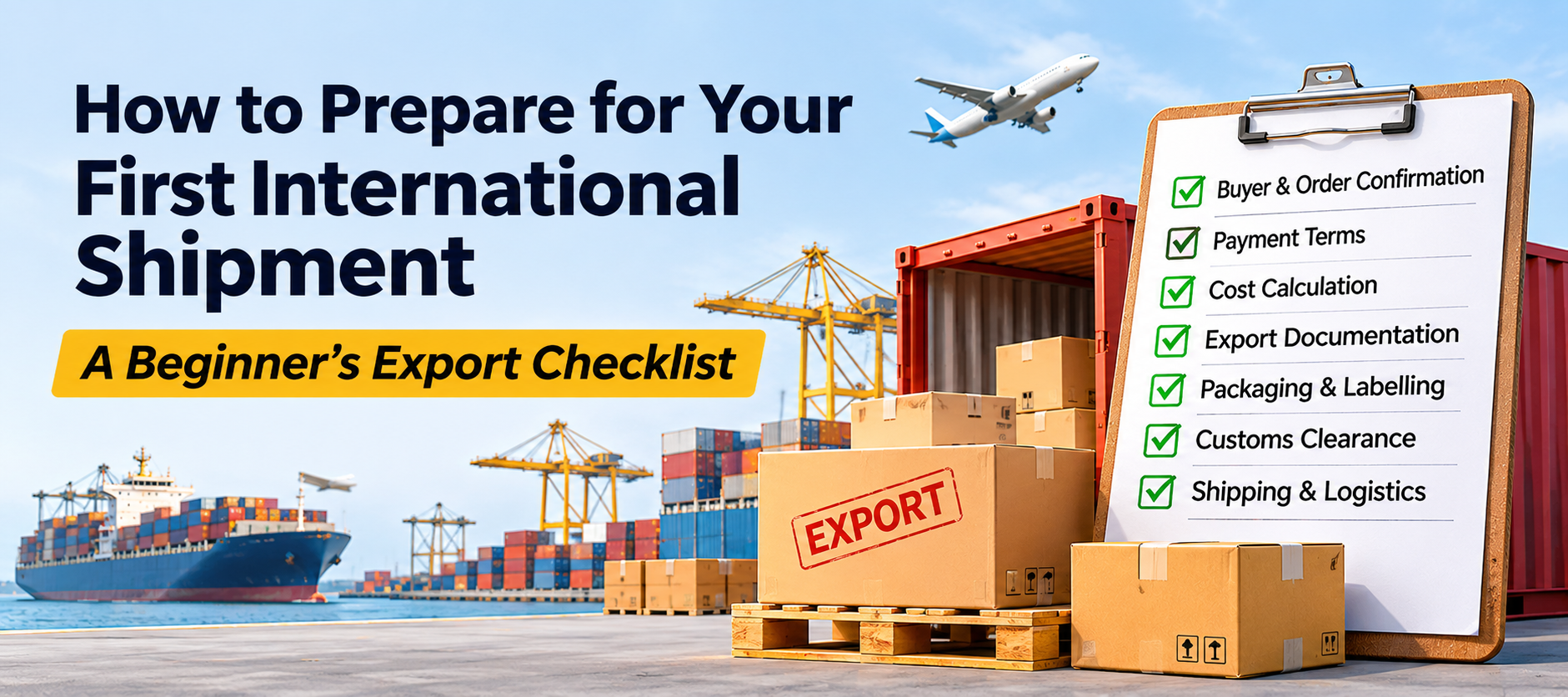
Preparing your first international shipment involves much more than packing products and sending them overseas. Follow this step-by-step export checklist — buyer confirmation, payment terms, documentation, packaging, customs clearance, and shipping — to get your first export right.
How to Prepare for Your First International Shipment: A Beginner's Export Checklist
Preparing your first international shipment is an important milestone in your export business in India. However, exporting is not simply about packing products and sending them overseas. You must confirm the buyer's order, finalise payment terms, prepare export documents, arrange packaging, calculate shipping costs, and coordinate customs clearance.A mistake at any stage can cause shipment delays, unexpected expenses, or payment problems.
Whether you are a manufacturer, merchant exporter, trader, or first-time entrepreneur — following a structured export shipment checklist can make the process much easier to manage.
Step 1: Confirm Your International Buyer and Order
Before preparing goods for shipment, make sure the order is genuine and all commercial terms are clear. Confirm the following details with your international buyer:- Product name, specifications, quantity, and quality requirements
- Unit price, total order value, and currency of payment
- Payment terms and delivery timeline
- Packaging and labelling requirements
- Shipping destination and agreed Incoterms
Why Is This Important?
A misunderstanding about quantity, product specifications, or delivery terms can create disputes after production or shipment. If you are dealing with a new buyer, verify the company's business details and assess the payment risk before committing significant money.GIFT includes international buyer finding and communication processes, helping learners identify potential buyers and manage professional export discussions — with 20+ methods for finding international buyers and suppliers.
Step 2: Finalise Payment Terms Before Shipping
Never treat an order confirmation as a guarantee that payment is secure. Before beginning production or dispatch, agree on the payment method and the conditions that must be met before shipment.Common export payment terms include:
- Advance Payment — The buyer pays before shipment
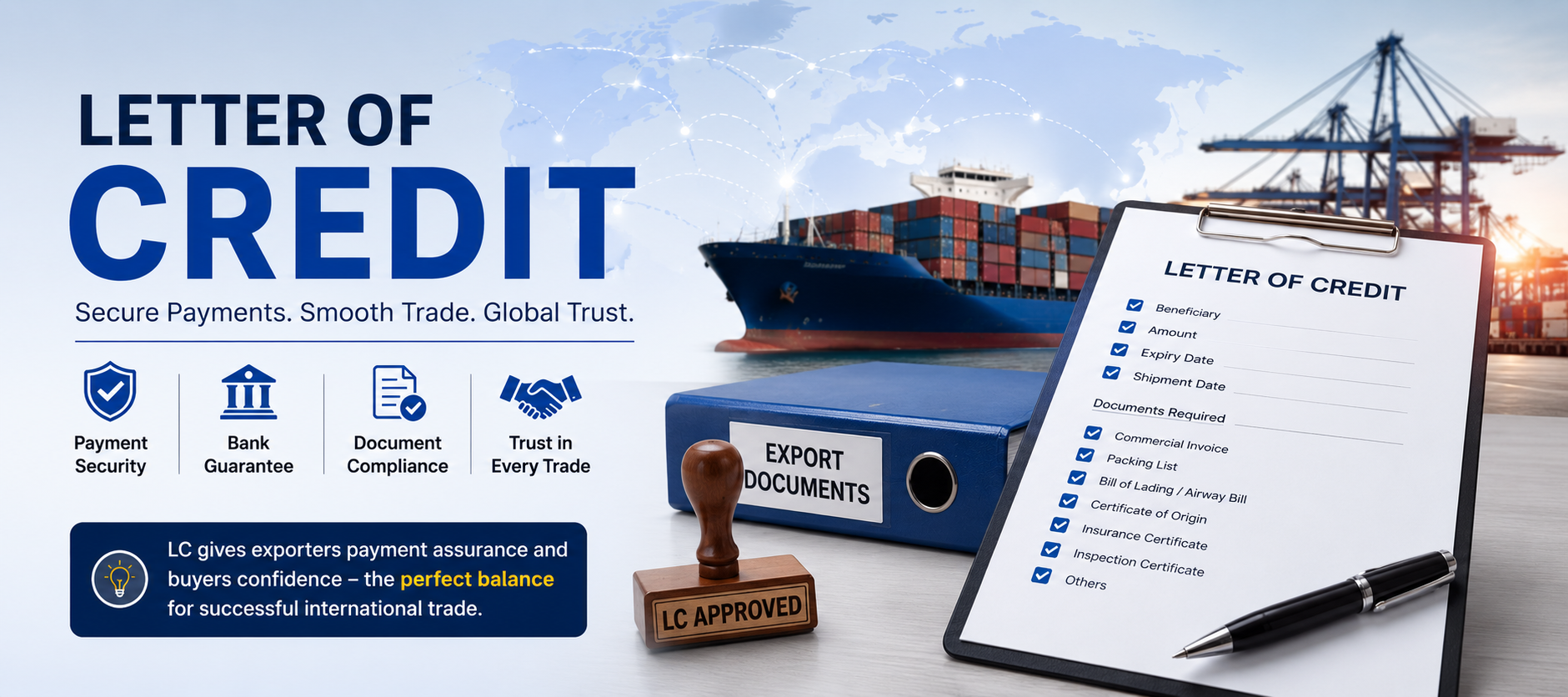
- Letter of Credit (LC) — A bank undertakes to pay against a compliant document presentation
- Documents Against Payment (DP) — The buyer pays before the shipping documents are released
- Documents Against Acceptance (DA) — The buyer accepts a payment obligation for a future date and receives documents under the agreed arrangement
Before dispatch, check:
- Are the agreed payment conditions fulfilled?
- Has the advance or other required payment actually been received?
- Have you verified the payment directly through your bank?
- Are the payment terms documented in writing?
A payment screenshot is not proof that money has reached your account. Always confirm through your bank before proceeding.
Step 3: Calculate the Complete Export Cost
One of the most common mistakes new exporters make is calculating only the product cost and forgetting shipment-related expenses. Before confirming the final quotation, calculate your complete export cost:| Cost Component | What to Consider |
|---|---|
| Product cost | Manufacturing or sourcing expenses |
| Packaging | Cartons, pallets, protective materials, and labels |
| Inland transport | Factory to warehouse, ICD, or port |
| Documentation | Applicable document and processing charges |
| Customs and handling | Relevant customs, terminal, and handling charges |
| Freight | Air freight or sea freight |
| Insurance | Where required or commercially appropriate |
| Bank charges | Applicable banking and payment charges |
| Other expenses | Inspection, certification, or product-specific requirements |
The actual expenses depend on the product, destination, shipment method, and agreed Incoterm.
Example:
Suppose you are exporting handicraft products worth ₹2,00,000. Your quotation should account for more than the ₹2,00,000 product value — packaging, inland transportation, documentation, handling, and freight may all affect the final cost depending on the agreed delivery terms.GIFT covers export-import processes, container booking and charge analysis, and shipping and logistics — helping students understand the practical cost components involved in international shipments.
Step 4: Prepare the Required Export Documents
Export documentation is essential for customs clearance, shipment processing, banking, and compliance. The exact documents required depend on the product, destination country, transaction, and applicable regulations.1. Commercial Invoice
Shows the seller, buyer, product description, quantity, unit price, total value, and other relevant transaction details.2. Packing List
Provides information about packages, contents, dimensions, weights, and other shipment details.3. Shipping Bill
The export customs declaration filed through the applicable Indian customs process.4. Bill of Lading or Air Waybill
The transport document issued for the relevant sea or air shipment.5. Certificate of Origin
Confirms the origin of goods where required or requested.6. Purchase Order and Proforma Invoice
These help document the agreed commercial terms and order details.7. Additional Certificates
Certain products may require inspection certificates, fumigation certificates, health certificates, licences, or other documents.Important Document Checks:
- Product description and quantity are consistent across all documents
- Values and currency match the agreed terms
- Buyer and consignee details are correct
- HS code classification has been checked
- Package count, weight, and dimensions are accurate
- Destination-specific documents have been identified
GIFT includes customs clearance and documentation training, helping beginners understand the role of export documents in the shipping process.
Step 5: Check Product Quality Before Packing
Do not wait until the buyer receives the shipment to discover a quality issue. Before dispatch, inspect the goods against the buyer's approved specifications.Your quality checklist should include:
- Product dimensions, specifications, colour, finish, and material
- Quantity and product variations
- Functionality, where applicable
- Defects or damage
- Buyer-approved samples, required labels, and markings
An incorrect product or damaged shipment can lead to complaints, replacement costs, delays, and disputes — catching quality issues before packing is always less costly than fixing them after.
Step 6: Arrange Proper Export Packaging
International cargo may pass through multiple handling points before reaching the buyer. Packaging must protect the goods throughout transportation.For Fragile Products:
- Use suitable cushioning materials and protect edges and delicate surfaces
- Prevent movement inside the carton and use strong cartons or crates when required
For Furniture and Bulky Products:
- Protect corners and surfaces and use appropriate carton strength
- Secure movable parts, measure packed dimensions accurately, and consider palletisation where appropriate
For Export Cartons, Check:
- Carton count, gross and net weight, dimensions
- Shipping marks, product labels, and handling instructions
- Buyer-specific packaging requirements
For wooden packaging materials used in international trade, check whether the destination and shipment require compliance with ISPM 15. GIFT includes branding and packaging as part of its curriculum, alongside practical export processes.
Step 7: Choose the Right Shipping Method
Your shipping method depends on the shipment's size, weight, urgency, destination, and budget.Air Freight:
Suitable for urgent, smaller, or higher-value shipments where speed is important.Sea Freight:
Often suitable for larger or heavier consignments where transit time allows.Sea freight may be arranged as:
- LCL (Less than Container Load) — Cargo shares container space with other shipments
- FCL (Full Container Load) — The shipment uses a full container under the agreed arrangement
Before booking, confirm:
- Cargo weight, volume, and readiness date
- Origin, destination, and transit time
- Freight quotation validity and origin/destination charges
- Customs clearance arrangements and insurance requirements
- Required shipping documents
Compare detailed quotations rather than choosing a logistics provider based only on the lowest advertised freight rate. GIFT covers container booking, charge analysis, customs clearance, and shipping and logistics — along with expert sessions with Customs House Agents and freight forwarders.
Step 8: Understand Your Incoterms
Incoterms define important responsibilities between buyers and sellers concerning delivery, costs, and risk transfer. Always specify the correct named place or port and the Incoterms version in your contract.Common terms include:
- EXW — The seller makes goods available at the agreed place with relatively limited delivery obligations
- FOB — Used for sea and inland waterway transport; the seller delivers the goods on board the nominated vessel at the named port of shipment
- CIF — Used for sea and inland waterway transport; the seller arranges and pays for carriage and required minimum insurance to the named destination port, while risk transfers at the port of shipment
- DAP — The seller arranges delivery to the named destination, ready for unloading
- DDP — The seller takes on extensive delivery and import-clearance responsibilities
Do not select an Incoterm without understanding the costs and responsibilities it creates. A wrong Incoterm can significantly affect your export pricing and profitability.
Step 9: Coordinate Customs Clearance
Before cargo can leave India, the applicable export customs procedures must be completed. The exporter or appointed customs broker generally coordinates the relevant documentation and filing process.Depending on the shipment, this may involve:
- Confirming the HS code and export policy requirements
- Preparing the required declarations and filing the shipping bill
- Providing supporting documents and responding to customs queries, if any
- Completing applicable examination or other formalities
- Obtaining the required customs clearance for export
GIFT specifically lists customs clearance and documentation among its course topics, helping students build a practical understanding of these steps.
Step 10: Complete the Final Pre-Dispatch Checklist
Before the shipment leaves your facility, conduct a final review:- Buyer order and product specifications confirmed
- Payment conditions checked and funds verified where applicable
- Product quality inspection completed
- Packaging and labels checked
- Carton count, weights, and dimensions confirmed
- Commercial invoice and packing list checked and matched
- Shipping instructions confirmed with the logistics provider
- Required export documents prepared
- Customs broker and clearance arrangements confirmed
- Insurance reviewed where applicable
- Buyer informed about the shipment plan
- Copies of all transaction documents saved
This checklist is a practical starting point, not a substitute for product-specific, destination-specific, or customs requirements.
Real-World Example: Preparing the First Furniture Export Shipment
Consider a hypothetical Indian furniture manufacturer receiving an order for 100 chairs from a buyer in Europe.Before dispatch, the exporter must:
Step 1 — Confirm Order
Confirm the order, specifications, and payment terms. Verify the buyer and agree on the Incoterm.Step 2 — Calculate Costs
Calculate the product, packaging, transport, and freight costs — not just the product price.Step 3 — Inspect Quality
Inspect the chairs for quality against the buyer's approved specifications.Step 4 — Pack and Measure
Pack the chairs securely and record carton dimensions and weights accurately.Step 5 — Prepare Documents
Prepare the commercial invoice, packing list, and other required documents with consistent details.Step 6 — Coordinate Shipment
Coordinate with the freight forwarder and customs broker and complete the export customs process.Step 7 — Inform Buyer
Send the buyer the relevant shipment information and tracking details.If the exporter forgets to calculate package dimensions correctly, the freight quotation may be inaccurate. If the invoice and packing list contain inconsistent details, the shipment may face delays. Every step connects to the next.
How GIFT By 10X Exports Helps You Prepare for Your First International Shipment
The GIFT – Global International Foreign Trade Program by 10X Exports is a 45-day, 100% offline and practical export-import training program in Ahmedabad, covering 250+ topics across 18 modules.1. Strong International Buyer-Finding Skills
GIFT lists 20+ methods for finding international buyers and suppliers, along with live buyer and supplier communication processes — so you have a buyer before you need a shipment.2. Practical Export Training
GIFT highlights live export-import projects, real-time case studies, and executing export-import processes while learning — connecting theory with actual business workflows.3. Documentation and Customs Clearance
Students learn about export documentation and customs clearance — two critical parts of preparing a shipment correctly.4. Shipping and Logistics Knowledge
The curriculum includes container booking, charge analysis, shipping and logistics, along with expert sessions involving Customs House Agents and freight forwarders.5. Packaging and Payment Safety
GIFT covers branding and packaging, as well as understanding how to safeguard international payments.6. Business Support and Industry Exposure
The official GIFT page lists first-trade support, customised planning and strategy, port visits, networking, and lifetime support — subject to the program's terms.👉 Explore the Official GIFT Export Import Training Program
Conclusion
Preparing your first international shipment becomes easier when you follow a clear, structured process.Start by confirming the buyer and order. Finalise payment terms, calculate your complete export cost, inspect product quality, prepare packaging, check documentation, and coordinate shipping and customs clearance.
Successful exporting is not only about sending products overseas — it also requires strong buyer finding, accurate export costing, practical documentation skills, payment-risk awareness, and logistics coordination.
Every step in the export process connects to the next. Missing one step does not just delay that step — it can affect the entire shipment.
Call To Action
GIFT By 10X Exports offers a 45-day practical export-import training program covering buyer finding, export documentation, payment safeguarding, customs clearance, shipping and logistics — along with live case studies and industry exposure.👉 Join GIFT Export Import Course in Ahmedabad
India's most practical export training — for students, beginners, and entrepreneurs.
🚀 Learn the process. Follow the checklist. Get your first shipment right.
Tags
Frequently Asked Questions
What are the key steps to prepare your first international shipment from India?
The key steps are: confirm the buyer and order in writing, finalise payment terms before production, calculate the complete export cost including freight and handling, inspect product quality, arrange proper export packaging, prepare all required documents, choose the right shipping method, understand your Incoterms, coordinate customs clearance, and complete a final pre-dispatch checklist. Every step connects to the next — skipping one can affect the entire shipment.
What documents are required for an international shipment from India?
Common documents include the commercial invoice, packing list, shipping bill, and Bill of Lading or Air Waybill. Depending on the product and destination, you may also need a certificate of origin, inspection certificate, fumigation certificate, or product-specific licences. Always prepare a shipment-specific document checklist and verify consistency across all documents.
Which payment method is safest for a first-time export order?
Advance payment is generally safest for a first export order because the exporter receives funds before shipment — eliminating buyer non-payment risk once the payment is verified through the bank. For larger orders, a properly structured Letter of Credit from an acceptable issuing bank can also provide strong protection.
How do I calculate the correct export price for my first shipment?
Your export price should include product cost, packaging, inland transportation, documentation charges, customs and handling charges, ocean or air freight, insurance (where applicable), and bank charges. The agreed Incoterm determines which costs the seller must include in the quotation — always specify the Incoterm and named place clearly.
Why is pre-shipment quality inspection important in export?
Pre-shipment quality inspection ensures the goods match the buyer's approved specifications before dispatch. Discovering a quality issue after the shipment has left India is far more costly — it can lead to complaints, replacement costs, return freight, and loss of the buyer relationship. Always inspect against approved samples and maintain records and photographs before packing.